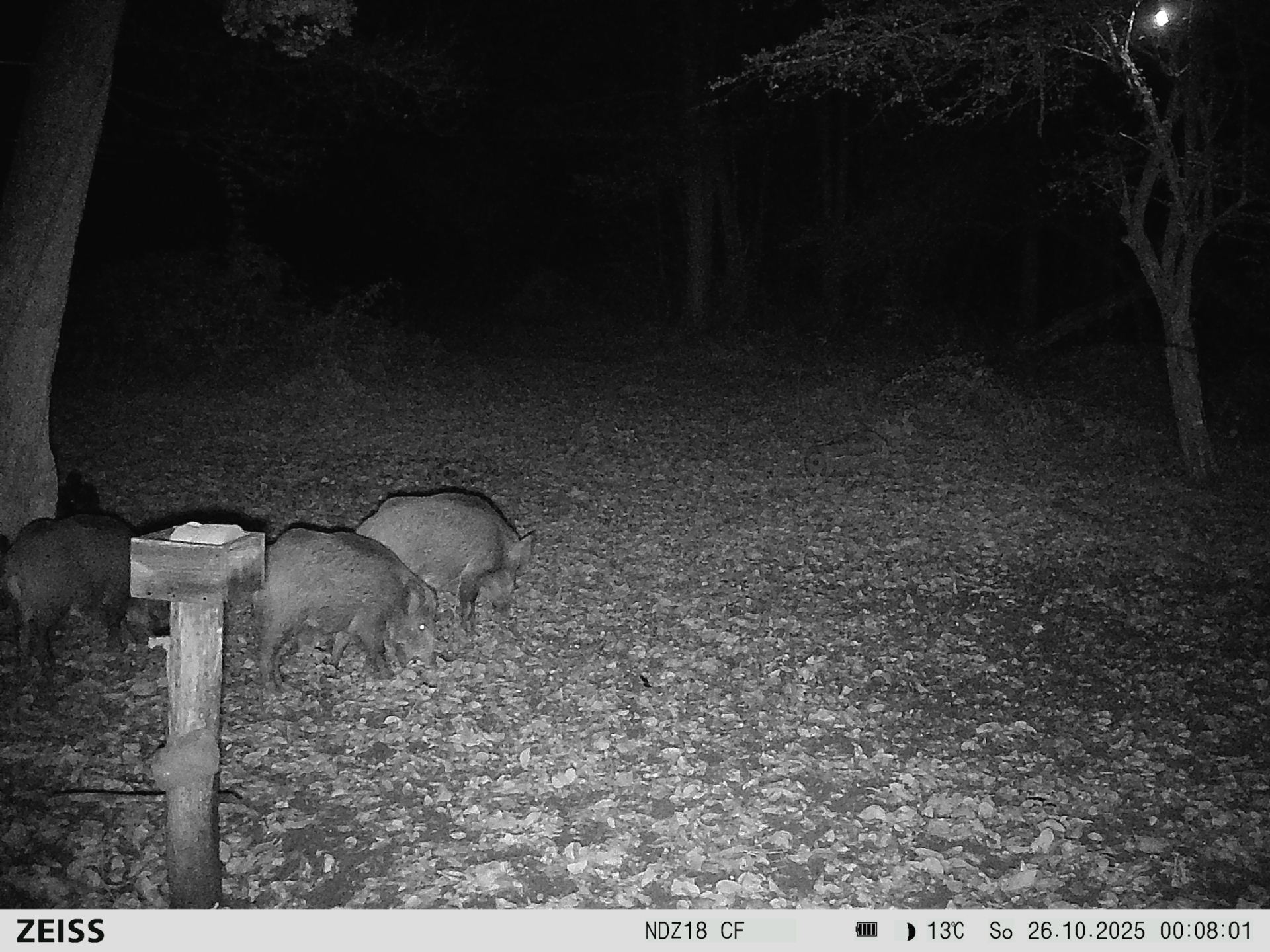
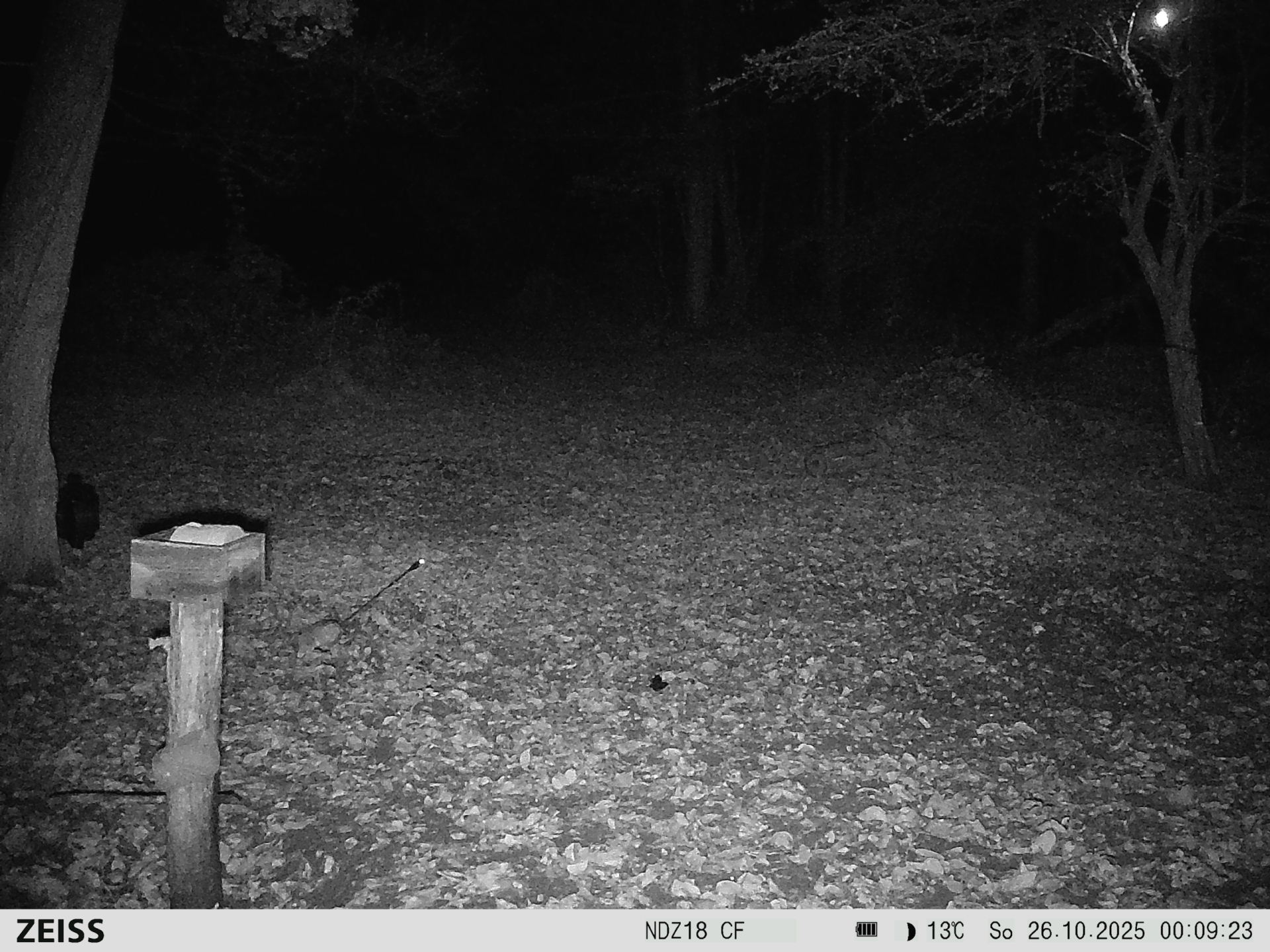
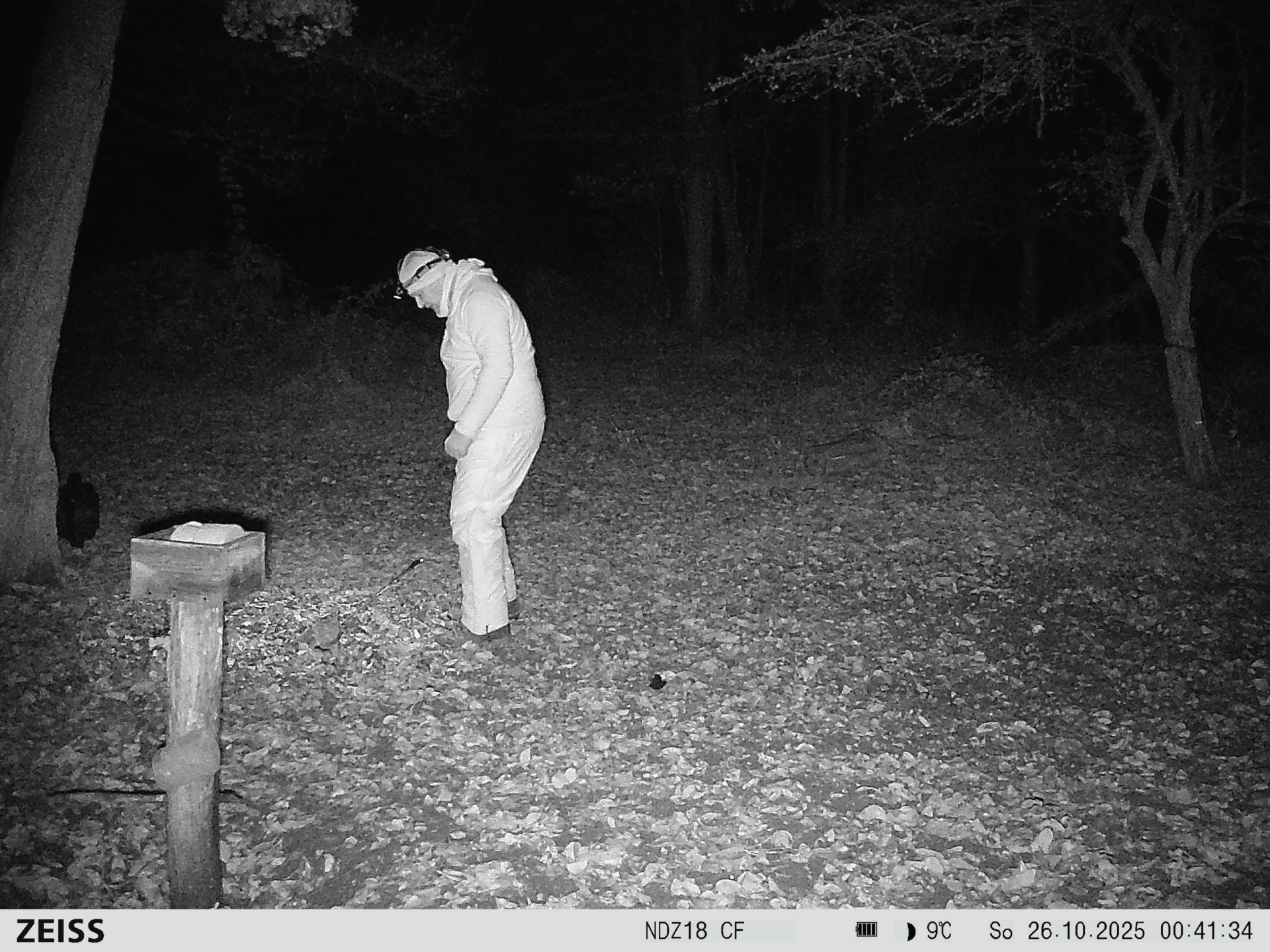
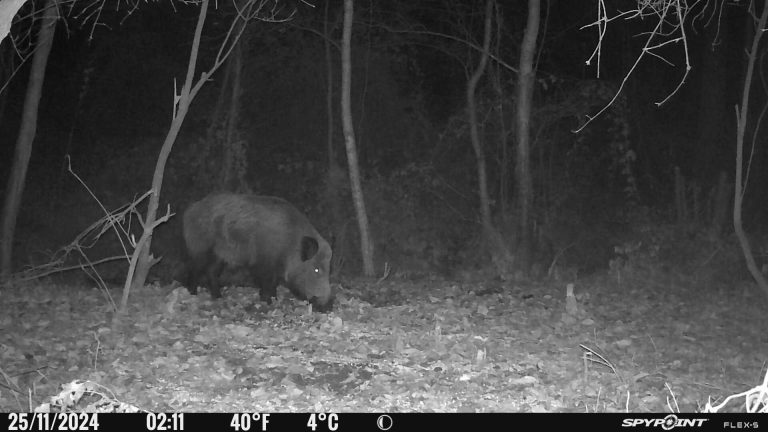
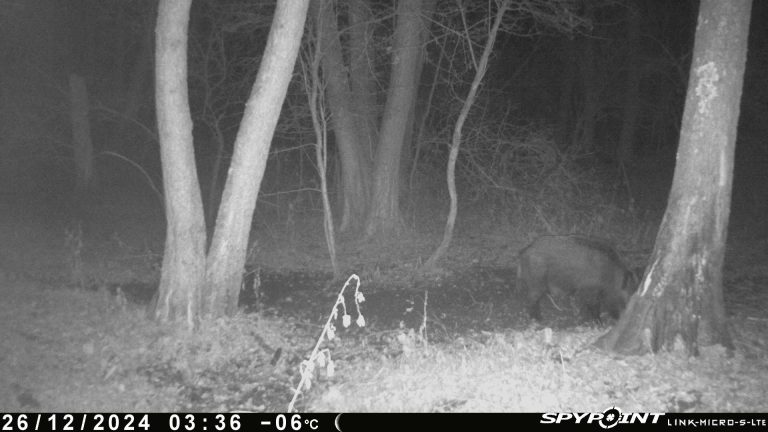
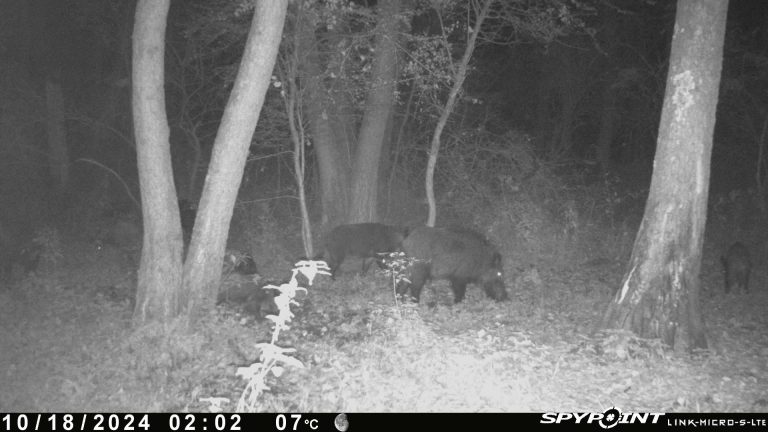
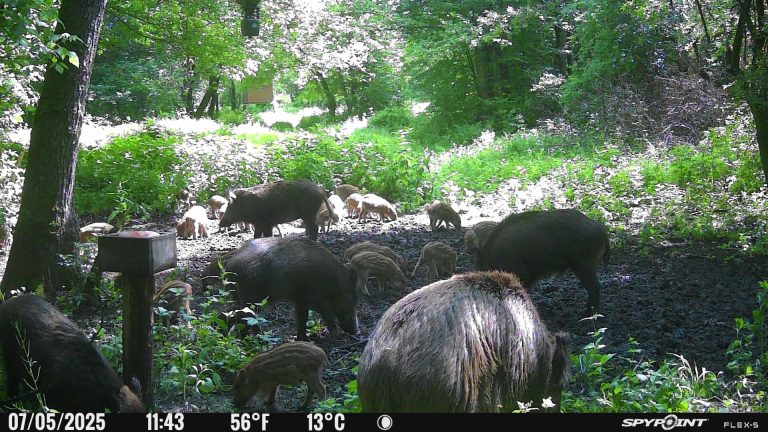
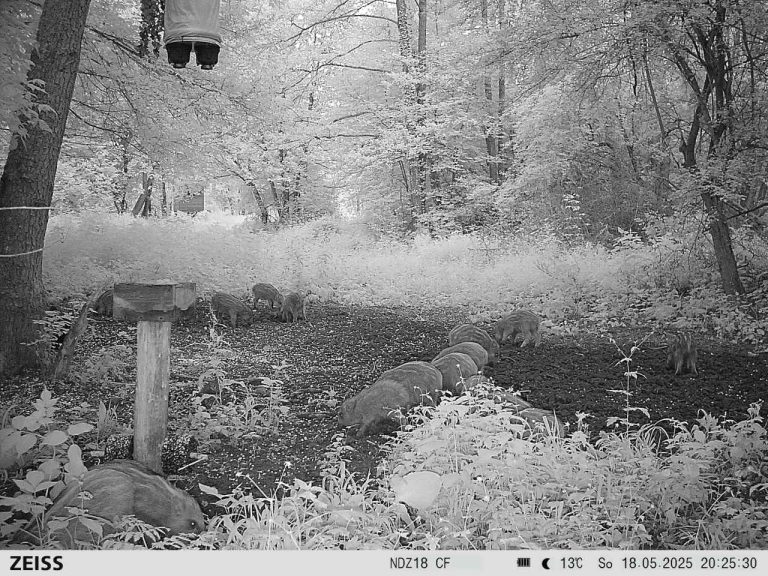
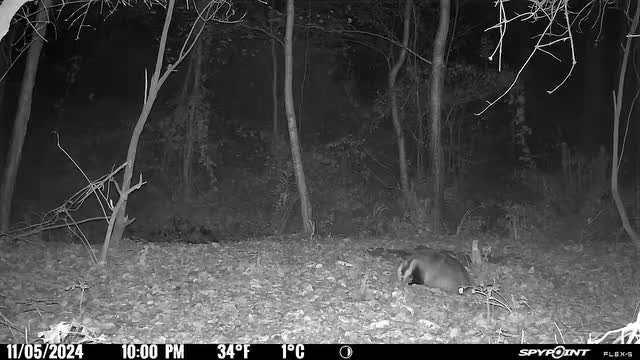
The last two weeks of trail camera photos, the weather forecast, and a bit of “terrain tidying”…
Given the last two weeks of trail camera photos, the weather forecast, and a bit of “terrain tidying intent,” I decided to head out to my automatic feeder stand at three in the morning on Saturday and spend the whole of Saturday night hunting. Thanks to the early start, I arrived comfortably around seven in the morning.
After topping up the feeder, I made some changes to the mounting of the stand that’s been up all year. Using the winch with different pulley systems to lower and raise the feeder’s hopper is, on its own, an exciting challenge: I want to find the most optimal gear ratio for moving a roughly 250 kg load with the power of the Eder Powerwinch 500.
Even at a 1:1 ratio, with just a single redirect pulley, the winch works perfectly.
At a 1:2 ratio I get the best result. In this setup one pulley works on the load side and one on the redirect side.
At a 1:3 ratio, with a double redirect pulley, the winch spins at relatively high revs, lifting very slowly but effortlessly.
I’ve also tried several other setups, for example a Friction Ring Dynema soft shackle with two rope-and-toggle knots and two aluminum rings — you can put together a genuinely astonishing torque multiplier this way.
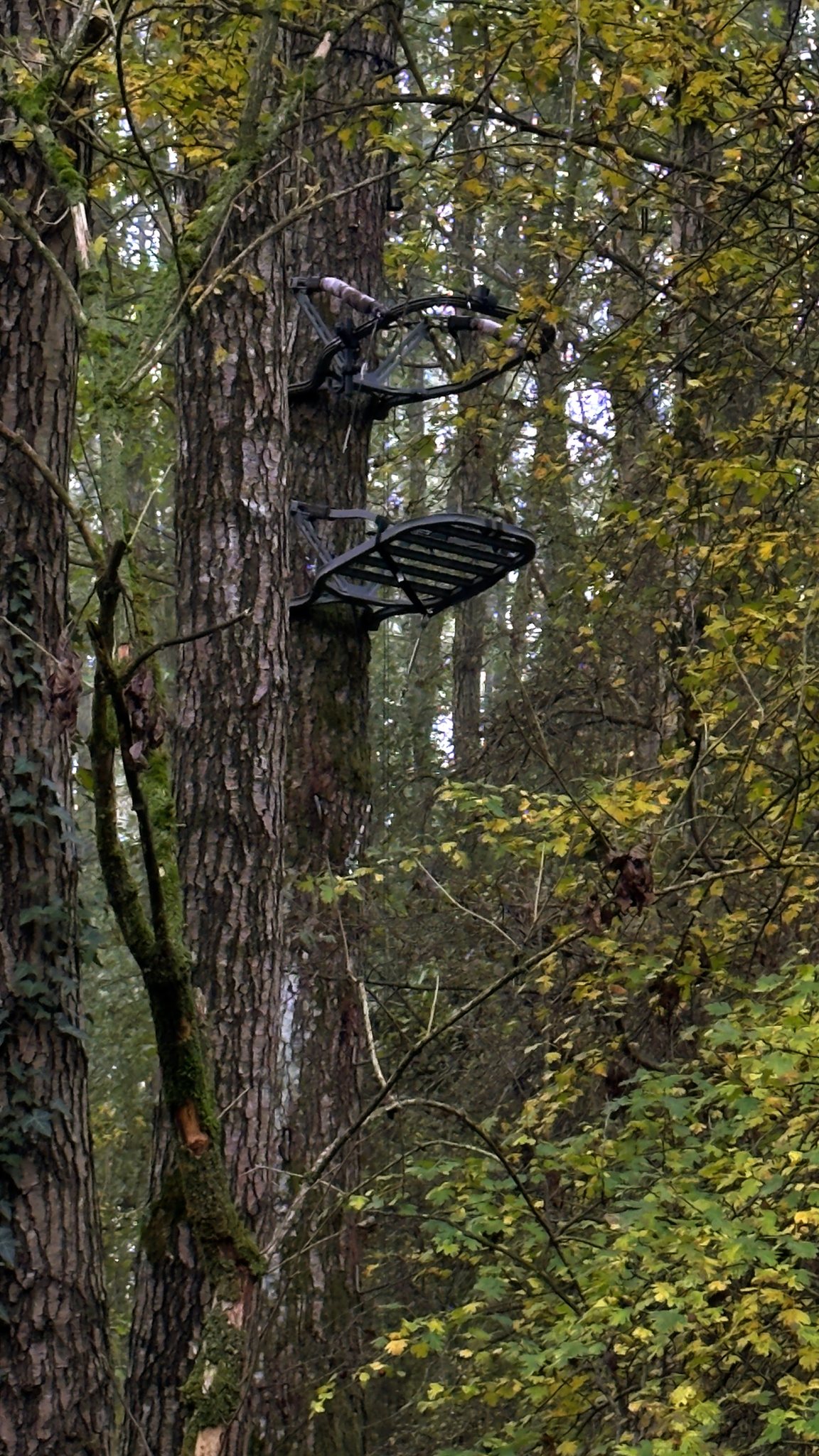
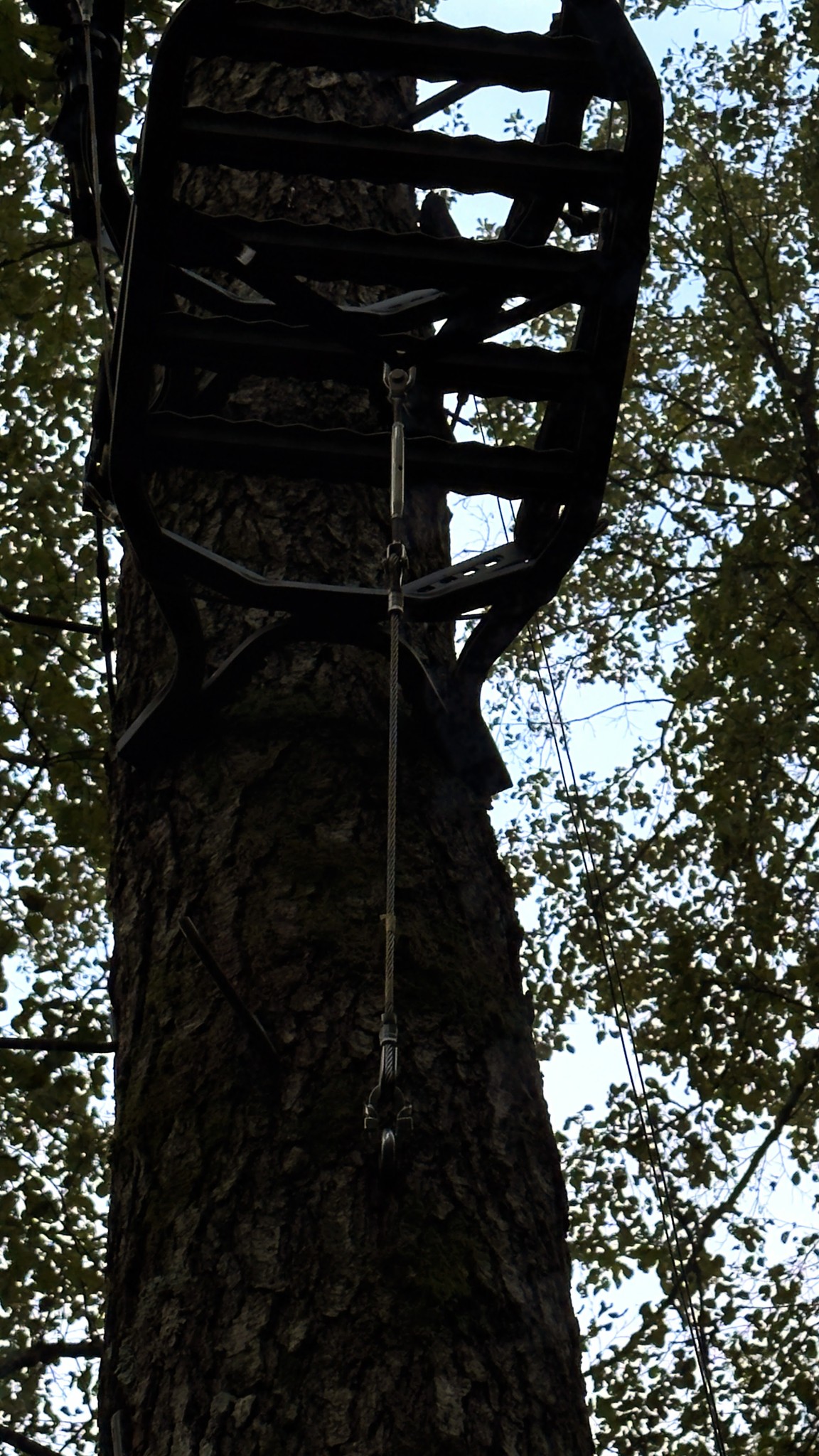
But back to securing the stand! Until now I’d tied the platform to the tree with a ratchet strap, and fastened the seat to the platform likewise with 25 mm tensioning straps. Since I wanted to minimize the stand’s visibility, instead of straps I used 6 mm and 4 mm 7×19 (seven strands of nineteen wires each) stainless steel flexible sailing wire rope, along with quality stainless steel turnbuckles. The result is not only barely visible but also rock-solid.
And that kind of reliable, stable anchoring is essential, because at night, in complete darkness, you absolutely have to be able to trust the stand’s stability — a single moment of doubt can be fatal.
It’s unpleasant even to imagine: the tree swaying slightly in a strengthening autumn wind while I stand on the platform in pitch darkness. It only takes a small wobble, a loss of balance at 8-10 meters up, where a bad anchor point can decide the whole night — or more.”
During the morning I carried up into the tree everything I judged necessary for the night: backpack, stand bag, hat kit, headlamp, arrow quiver with the reflector arm, rangefinder, small thermos full of hot tea, handheld thermal camera, headband, wind indicator, hand-warmer muff — all set out and ready.
I hung up my hunting clothing and my bow too, arranging everything around me on the stand. And of course, from that list, I can’t leave out the properly modified stand seat cushion, nor the 20 mm thick wool felt “stand rug” cut to fit the platform.
From the factory seat cushion of the stand I removed the original cheap lining material. In its place, working from bottom to top, the layers were built up in the following order:
at the very bottom a layer cut from a TrekMates closed-cell sleeping mat,
above that a 10 mm thick double-walled polycarbonate stiffening sheet,
above that a layer cut from 20 mm thick VFG wool felt,
above that a thin layer of foam, and finally the electric seat-heating pad.
The seat heating does an excellent job below zero Celsius, even with very thick clothing on.
The warmth arriving from below is nicely carried by the bloodstream to every distant extremity, as if an inner fire were blazing in rebellion against the cold.
On top of that, if I get soaked, it helps dry the cushion quickly. After all this I left everything out for a good ten hours to air out properly.
The aforementioned 20 mm thick wool felt stand rug is likewise a multi-purpose tool.
Its main function is to reduce the metallic noise of the stand’s platform.
Because the big lugs and ridges on the sole of a boot or stand boot can sometimes land on the metal stiffeners in just such a way that, under load, one or the other slips.
And that’s a big problem — a lot of noise.
This is meant to eliminate that noise source from the system entirely.
Besides, it also makes a nice little “island” in the damp, sometimes wet leaf litter for changing clothes in the morning.
At five in the afternoon I approached the tree quietly along the little brushy path behind the stand, and once up there, changed and watched the forest’s autumn life — the softly falling autumn leaves’ yellowish rust, the distant birdsong, the scent of damp earth, all whispering that this is exactly where I’m meant to be.
Why do I change clothes at the stand? A lot of people have asked me that… It’s very simple: getting to the stand means walking along a 300-meter path overgrown with undergrowth and nettles, where, given the game density, ticks are abundant and varied, and it’s easy to fall victim to them. Since I spend 12-14 hours up there, mostly motionless on the stand, the ticks would have plenty of time to crawl to the body parts that suit them better — the thinner-skinned folds and softer areas — and burrow in. To prevent this, my walking clothes, shoes, and socks go into a dry bag.
Well, after all these preparations, I can say this was the most active and exciting night hunt I’ve experienced so far.
Saturday evening, 7:30-9:00 PM
Around half past seven the roughly 70-80 kg sow that shows up every evening arrived. That was actually one of the reasons for tonight’s “one-night” adventure. This time she came from the direction of the Big Wallow, and through the thermal camera I could see her creeping cautiously beneath the bushes that were thinning out with the leaf fall. It was already dark — that deep, tangible darkness where the trees are only shadows of shadows. Without the thermal camera I wouldn’t have seen a thing. She arrived in absolute silence: no sound, no snapping branch, not even the rustle of dry leaf litter. I have no idea how she does it — as if she materializes out of nothing, soundlessly, like a ghost.
Anyway, she arrived.
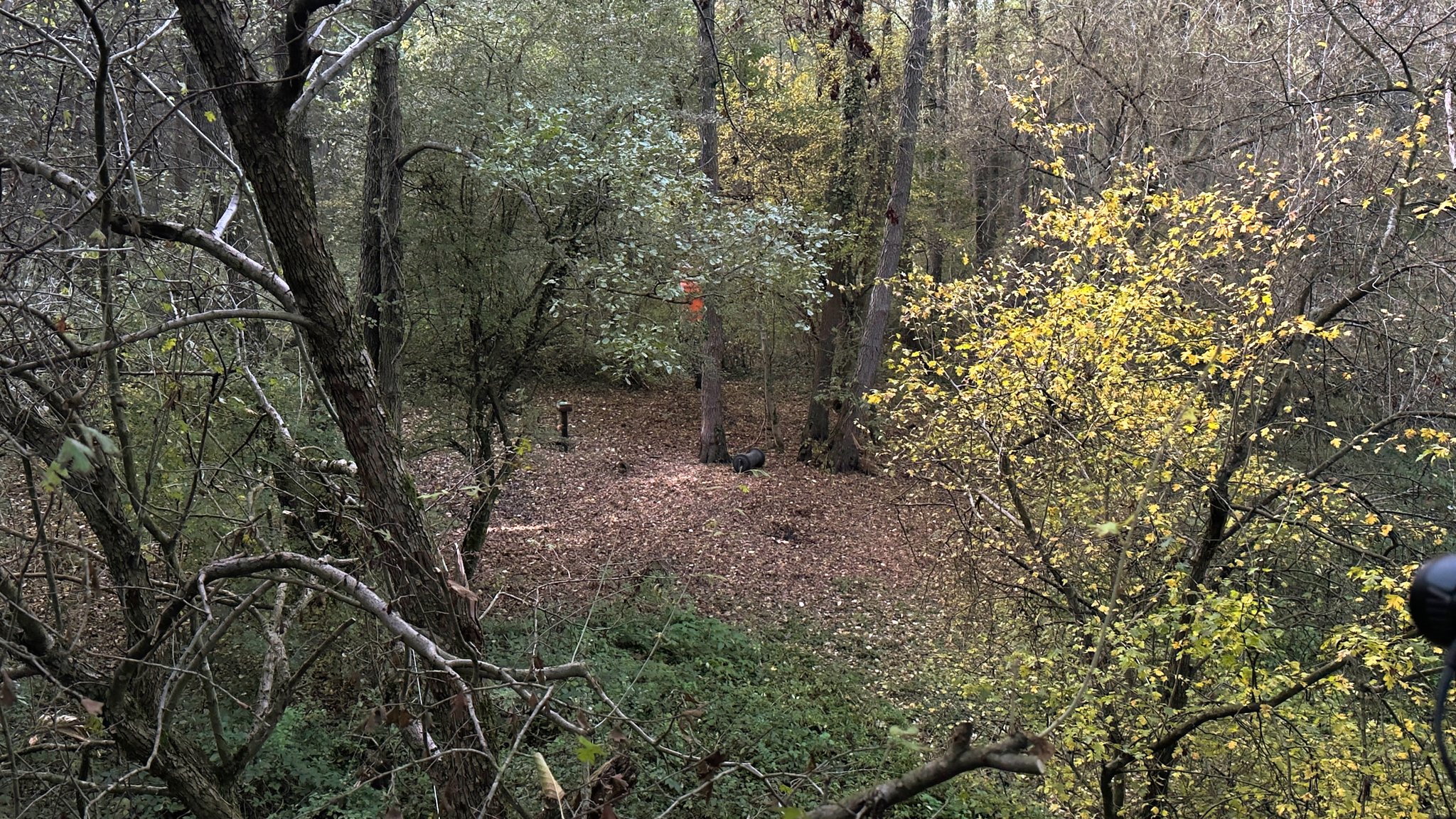
At the edge of the feeder, on a patch of ground that’s always soaked and soft, she picked and rooted through the corn, the squelching sound of the wet earth the only sign giving away her presence.
After a few minutes I thought I’d turn on my stand lights, just to conjure up some kind of shooting light in the pitch-black night.
Well, lately the Sidus Link app has been infuriatingly slow to find the Bluetooth connection to the lights, only managing it after umpteen attempts. It used to be fast and rock-solid, but after some “update” that was supposedly a bug fix, they thoroughly botched it. “How I hate the arrogant, useless world of software developers!” I muttered to myself, sweat beading on my forehead from the tension.
After I finally managed to get the connection working with the lights, the moment even one lamp’s faintest, barely glowing red light appeared — not nearly enough to illuminate anything, let alone the feeder — the pig went crashing off in a panic.
/ The Aputure MC Pro lights work perfectly silently.
Among its many other excellent qualities (proven storm-resistant, lasts a full night on its own battery, any color profile can be set up… there’s a lot more) this was one of the main reasons I chose it. /
“So this is your survival strategy: staying only in the thicket, in the shadows, under the bushes. At the slightest change, off you go!” I thought bitterly.
She didn’t go far, but it took a long time before she worked up the courage to come back. She hadn’t heard me, hadn’t caught my scent. She just kept rooting at the edge of the feeder, protected by the dense brush. I never had a chance to raise the bow.
That my concealment went unnoticed by the animal, 25 meters from the feeder, was well confirmed by the fact that the next day, in the same time window, she showed up again in exactly the same spot, exactly the same way.
So she hadn’t held my lighting experiment from the previous evening against me at all.
Around nine o’clock a sow with eleven piglets showed up.
The sow followed the same method as the previous doe pig: likewise, she was only willing to pick up the available kernels under cover of the bushes.
What was truly interesting, though, was watching her instill this same behavior in her piglets — a maternal instinct that works with iron precision in the wild.
Here I did manage to get the light on, and at 80% red I could see the entire feeder area, the yellowish glint of corn kernels on the wet ground.
But the pigs simply would not come into the area visible to me.
Whenever a piglet, picking up corn and stepping along nicely, would have wandered out into the lighter part, the sow would rush over and chase it back into the safe darkness.
At first I didn’t understand why she kept herding her piglets around, but then it clicked: very cleverly, she wasn’t letting them out into the “danger zone,” where the light might give them away.
This group stayed at the feeder for close to an hour and a half; I must have stood up, drawn the bow, and sat back down a dozen times, my heartbeat pounding louder and louder in my throat.
I couldn’t get a clean, unambiguous shot at a single piglet.
When they were done, they moved on nicely, as if they’d never been there at all.
Not long before midnight the little orphaned band of piglets — now down to just four individuals — arrived.
Once they started, gradually approaching from the thicket, picking up the corn scattered by the automatic feeder, and reached the edge of the feeder’s small clearing, the stand lights again glowed red.
The thermal image showed no reaction whatsoever. Watching their every movement continuously, I gradually raised the lights’ brightness until I reached shooting light — the air practically vibrated with anticipation.
All that remained was to wait for the piglets to come into the area lit by the lamps.
Since the lights are mounted on branches of the trees at the edge of the feeder, and some branches hang in front of them, there are patches left in shadow even with the lights on.
Well, these little creatures, with uncanny instinct, moved exclusively through the areas shielded from the light.
With a bit of exaggeration: if I’d photographed the evenly scattered corn kernels on the ground from above, I’m almost certain the pattern of picked-up kernels would have traced out exactly the pattern of the branches’ shadows cast by the lamps.
What’s more, they kept constantly shifting, turning, showing their backs, then facing me — so the barely visible piglet-shadow presented, from 25 meters, a target area about the size of a tennis ball.
On one of these seemingly promising occasions I managed to shoot elegantly under one of the piglets, hitting a sizable root chunk dead center.
The sound of impact was exactly like a mountain breaking a shoulder blade, but the piglets’ reaction — just a brief scatter, then a cautious return — was nowhere near as hopeful.
So I have to agree with one of my fellow bowhunters, who holds the view that he’d gladly trade many, many nights of hunting for a single day hunt.