In the first few years of my bowhunting career, which began in 2004, I had already worked out…
In the first few years of my bowhunting career, which began in 2004, I had already worked out what kind of sight I could use to compensate for that unusual, almost defiant, deeply masochistic peculiarity of being "right-handed with the bow, left-eye dominant" that I’ve simply had to live with, since switching over to a left-handed bow was something I could never quite bring myself to do.
Over the years I had the chance to try one hunting sight after another, each better than the last, along with a less traditional one pushing the boundaries of technology – the Garmin A1i rangefinding digital sight.
Because of its unusual design, I even had a separate left-offset piece custom made for it, once the factory adjustment range proved insufficient.
Right at the start of this sight’s life cycle, I managed to take a piglet that appeared unexpectedly from a stream bed, at a distance I hadn’t anticipated.
If it had lived up to the hopes I’d pinned on it, and met the pragmatic expectations that had crystallized in me over time, I might still be using it to this day.
Alongside its undeniable advantages:
– The ability to set up multiple arrow profiles
– An electronic level
– It positioned the aiming dots well for the given distances
– The stalking mode proved especially useful, in that the sight didn’t switch off completely, only into a sleep mode, from which it could be woken very quickly with the grip switch
unfortunately it also had a few very annoying flaws:
– It would only run on disposable batteries, not on same-sized rechargeables.
– If I’d needed to change the battery in the dark, during an all-night stand hunt, I could only have done so at considerable risk, and only with the right hex key in hand, by removing a cover held on by four tiny screws.
– It almost never held a precise setting after just one calibration – I always found I had to recalibrate every distance again.
– Automatic brightness control wasn’t its strong suit; it always had to be checked, or adjusted, before a hunt.
– The power consumption stated in the manual bore no relation to reality whatsoever, and as that reality set in, all I could rely on instead of the rangefinding auto-adjustment was the fixed pin row.
– Since, because I aim with my left eye, the arrow’s longitudinal axis didn’t line up with the sight’s central axis, the rangefinding itself was inaccurate too, because it measured a different distance than the one I was actually aiming at. Always a bit off.
This was often a very serious problem.
The bottom line is that for a decade now, my sight has been an EOTECH Holographic Bowsight, the design that comes closest to a true red-dot.
In winter, in summer, in pouring rain, in storms, it’s a perfectly reliable, extremely well-designed piece of kit.
Unlike aiming with a conventional sight, here there’s no need for a peep, nor for the arrow’s longitudinal axis to line up with the sight’s central axis.
All that’s needed is for the outer "positioning" circle shown on the holographic display to line up with the pins of the inner aiming circle, and for the "red dot" at its center to sit on the point you’ve picked as your target.
The vertical movement of the sight for different target distances was handled by an extremely simple, solid HHA Picatinny mount with "reverse movement" – meaning moving the lever upward moves the sight downward.
After replacing the mount’s factory steel screws and washers with stainless ones, the aluminum mount, once disassembled the first time and reassembled precisely – "rattle-free-but-not-yet-binding" – and given a light greasing, became, thanks to its sheer simplicity, an indestructible piece for life.
However – and this overrides everything else – its huge drawback is that it’s simply impossible to set it up to behave like a smooth, "fluid" mount when you need to adjust distance.
I figured this out very early on, and I’ve been looking ever since for a chance to finally part ways with this rugged, crude piece, which – like a stiff-bodied, stubborn, willful donkey – sometimes suddenly jumps, and then, despite firm coaxing, refuses to budge even a little.
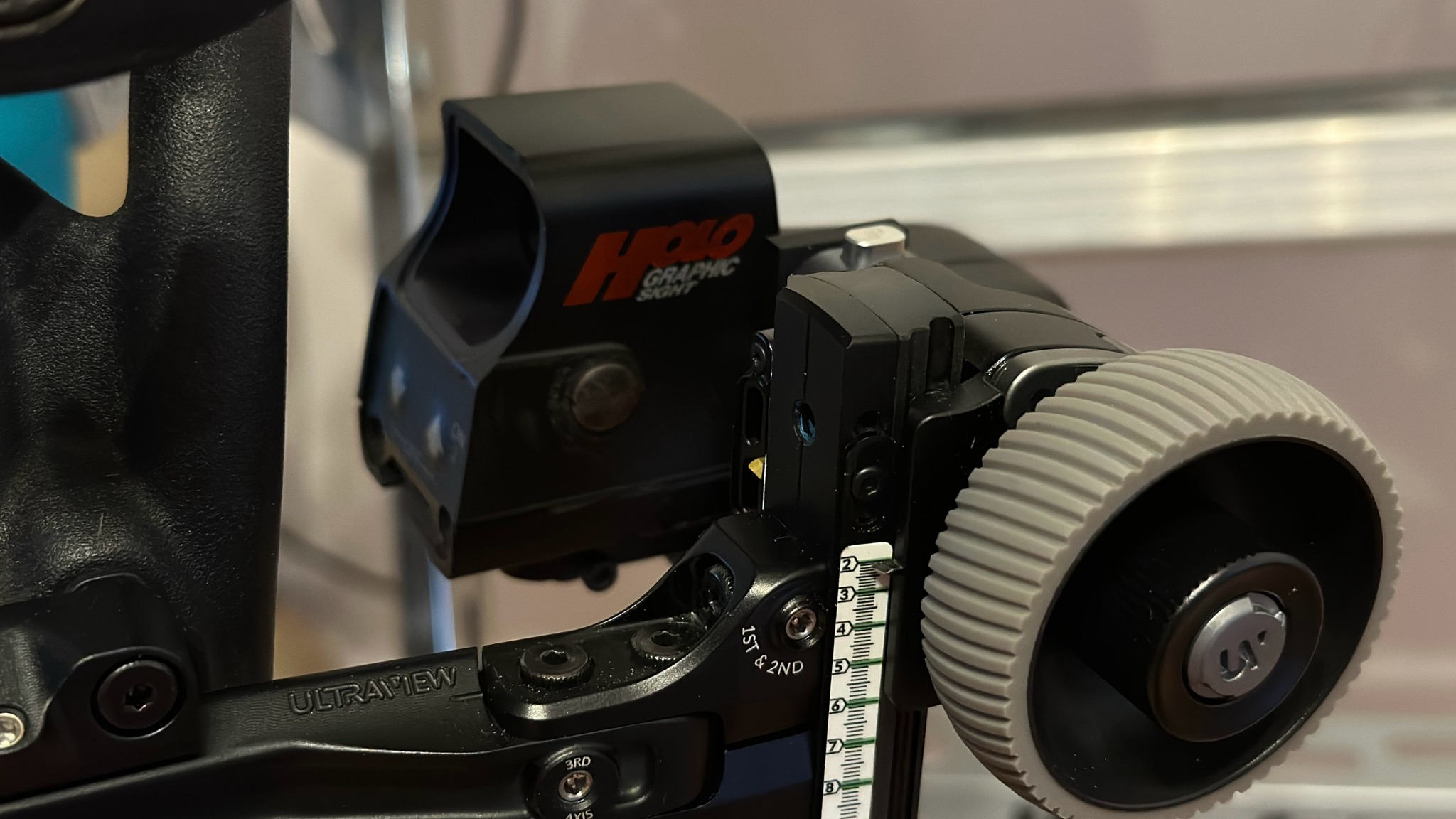
( photo 1 )
The perfect solution turned out to be a clever marriage of the Ultraview Slider and the HoloSight.
Here the main problem was mounting the considerably heavier, bulkier HoloSight in place of UV’s factory-standard, feather-light, modular scope, built with a level of care I’ve never encountered anywhere else.
With the solution I built, just the sight itself – independent of the UV mechanism – can be lifted off with one elegant, easy motion whenever needed.
Of course, the question immediately arises;
– When on earth would you actually need something like that, in a real hunting situation?
The answer is provided by nature itself, and one unfortunate wounding;
On one hunt, I managed to bring down upon myself the sky’s full thundering wrath, its flashing fury, its boundless blessing, as the Zala storm front swept right across Somogy County as well.
During one such stormy hunt, when for hours the water quite literally poured down on me, my hands were wrinkled like raisins, and every other piece of my outer gear was soaked through, it would have been extremely useful if the sight itself had stayed dry.
Toward the end of the storm’s fury, I heard corn crunching at the feeder.
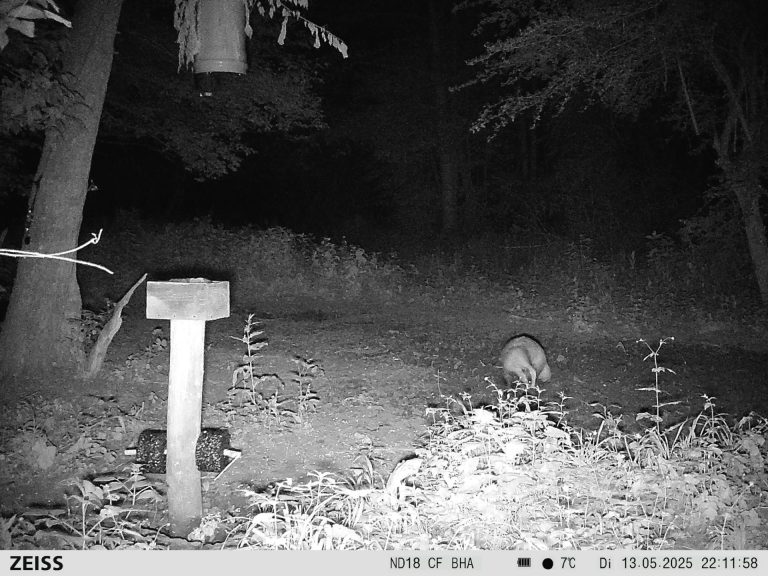
I reached for the thermal camera, and there was a sizeable boar dragging cobs out of the brush behind the feeder and eating them at the foot of the bush. After he’d already "stolen" cob after cob for himself, he had to reach further and further out for the next ones.
During one such move out into the open, I drew the bow, only to see, to my shock, that the light of the sight’s circles had been completely blurred by the wet lens window.
I had no chance to wipe it while the bow was drawn, and I tried to shoot as it was.
It ended in a wounding shot 🙁
So, there is that situation where it’s very handy if I can lift off just the sight on its own – because if I take off the Ultraview’s whole mount, the distance has to be reset when putting it back on, which, on a pitch-black night, can sometimes be a real problem.
Alongside the wonderfully smooth, precise mechanics, there was another source of enjoyment for me.
It’s worth mentioning that both the Ultraview Slider and the HoloSight allow for setting up two arrow profiles.
On the UV Slider – as anyone familiar with it knows – there’s an outer scale and an inner scale.
On mine, the inner scale is set to show distance from 15 to 45m matched to the ballistic characteristics of a 534-grain, 4mm Easton Procomp 250-spine arrow, while the outer scale is marked from 15 to 45m taking into account the flight characteristics of a 634-grain Easton 4mm FMJ 250-spine arrow.
( photo 2 )
Retuning and readjusting the sight.
I got past the problem of the mechanical union relatively easily.
Since the precision UV slider is a far more complex piece than the earlier, dead-simple mount, extra care has to be taken to tighten every screw and fastener to just the right torque.
For this job I used a Proxxon micro torque screwdriver.
Tuning and adjusting the sight, however, gave me a real headache.
Describing this problem in detail would be quite complicated, drawn-out, and oppressively boring, so just the essentials:
The earlier mount allowed the sight to be tilted forward and back.
This is needed in order to set the proper viewing angle.
The sight’s viewing angle is correct when the sight can be moved across the widest possible vertical range while the aiming circles remain fully, and reasonably comfortably, visible in their entirety.
With a poorly set viewing angle, the maximum usable shooting range generally drops drastically.
Before this dawned on me, I struggled for weeks, because I simply couldn’t get the aiming circles onto a target farther than 25m.
This mount doesn’t support forward-and-back tilting of the sight at all, so it has to be done using 0.1mm shims placed under the screws that hold the Picatinny rail carrying the HoloSight.
I’m well on my way, but I still haven’t reached the ideal setup.