Analysis of Adaptive Survival Strategies of the Wild Boar Population (Sus scrofa) Under Anthropogenic Pressure
Analysis of adaptive survival strategies of the wild boar population (Sus scrofa) under anthropogenic pressure.
1. The relationship between socio-ecological behavioral patterns and habitat stability
Observations show marked differences in the behavior of wild boar populations (mainly sows and their sounders) depending on habitat security and threat level.
In low-threat areas (a long-quiet, calm, undisturbed, safe environment with minimized anthropogenic impact):
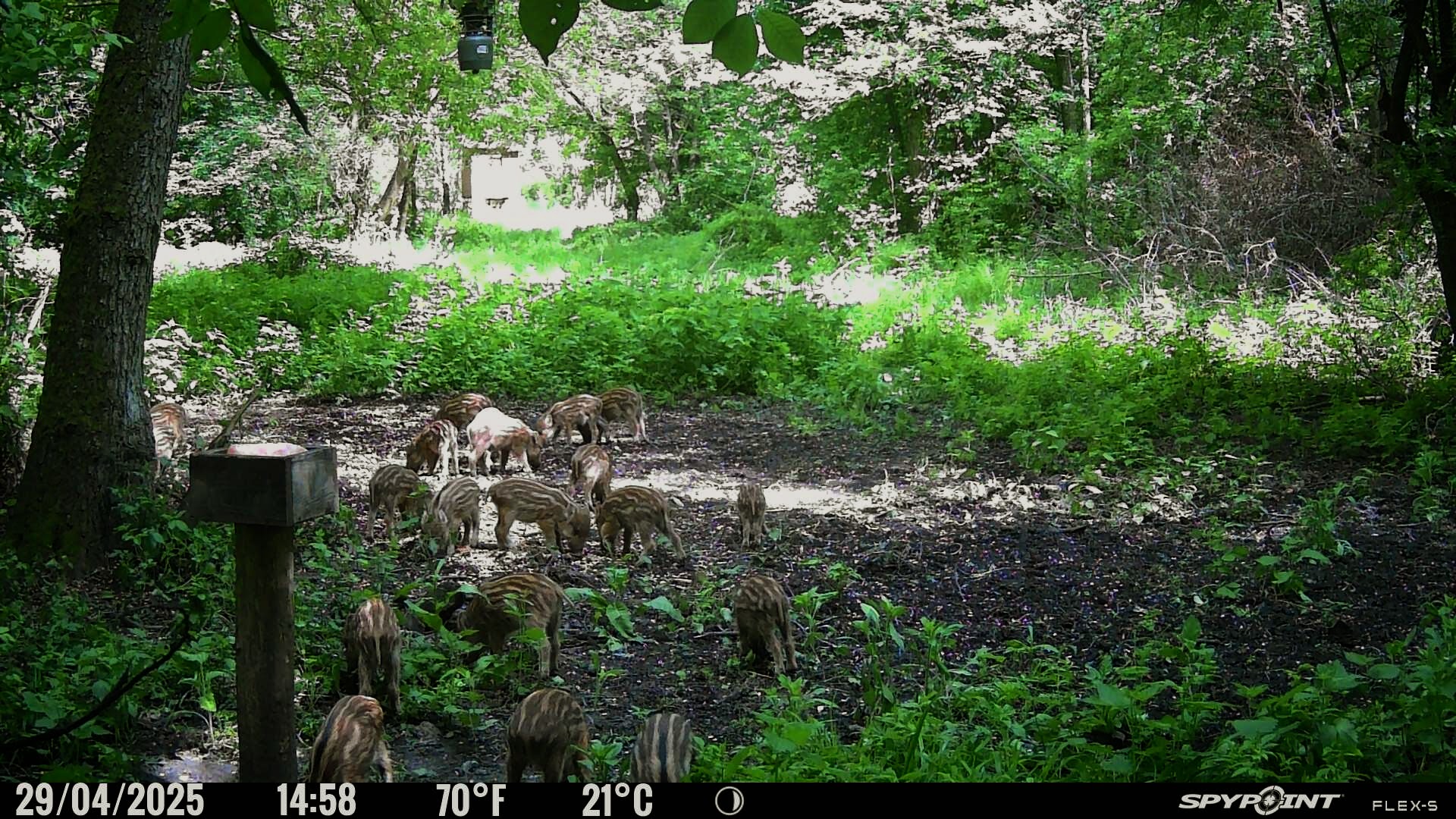
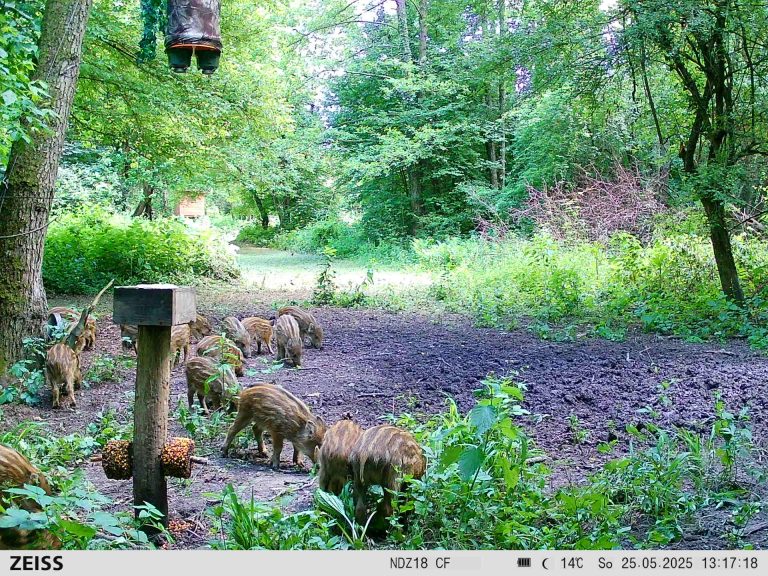
Sows employ a collective protection strategy, in which several sounders simultaneously and cooperatively use the same feeding or wallowing area (see, e.g., the cover photo).
This phenomenon can be explained by the theory of “communal vigilance,” where group presence reduces the predation risk borne by any single individual.
Piglets (0–6 months old) can move freely, since the “safety bubble” provided by the adults allows foraging to be optimized at any time of day.
2. Risk management and strategies of maternal investment
Sow behavior can be interpreted within the framework of “trade-off theory,” where a dynamic balance is observed between maternal energy investment and the offspring’s chances of survival.
Under moderate threat
(e.g., suboptimal noise levels or occasional human presence):
Sows shift to proactive risk assessment.
“Frontline vigilance” becomes characteristic, with the sow moving ahead at the front of the group to assess potential sources of danger (e.g., predators, human activity, traces of presence).
Piglet movement is regulated by the adults’ body posture (e.g., ear orientation, tail flicking, herding, low vocalizations), which is an example of “food-chain synchronization.”
In high-threat environments (e.g., increased noise from logging, proximity to roads passing through forest, or other frequent disturbances):
The population adopts an “offspring sacrifice strategy.”
Piglets are pushed to the periphery of the group, while sows stay farther away with the sounder (see camera data — 60 images/hour, idle time 1 minute).
This behavior can be explained by the evolutionary adaptation of “bet-hedging,” in which adult survival is prioritized over the long-term survival of every individual in the sounder (in the case of 18 piglets).
Despite the high mortality of piglets (30–50% in the first year), this strategy is adaptive at the population level, since protecting the reproductively capable adults ensures the gene pool is passed on.
3. Temporal and spatial habitat selection under anthropogenic stress
The camera data (early afternoon activity, 1-hour observation window) supports the phenomenon of “temporal niche shift.”
Wild boars restrict their movement to daylight hours, minimizing the combined risk of nocturnal predators (e.g., wolf, golden jackal) and human activity.
Avoidance of the area around wildlife management facilities (e.g., 24–72 hour absence) is a consequence of the “cumulative disturbance effect,” in which recurring stressors trigger long-term habitat memory.
4. Implications for wildlife management
Disturbance management: Establishing undisturbed breeding zones is critical from spring through late autumn, when sows are in the sensitive phase of raising piglets.
Predator control: Regulating excessive predator populations (e.g., golden jackal) and minimizing human activity can reduce the pressure that forces piglets into peripheral positioning.
Behavior-based monitoring: Analyzing trail camera data with machine learning could enable predictive modeling of risk strategies.
Conclusion:
The survival strategies of wild boar populations are built not merely on instinct, but on a complex cost-benefit analysis.
Sow decisions (e.g., sacrificing piglets vs. sounder survival) can be understood within the framework of r/K selection theory.
R-strategy and compensation for mortality: an evolutionary cost-benefit balance
The “r-strategy” is an evolutionary adaptation used by species that frequently face high mortality in their environment (e.g., predators, disease, anthropogenic stress). The essence of the strategy is that the species follows the principle of “quantity over quality”:
High reproductive rate:
The r-strategy is characterized by an extremely high number of offspring (e.g., in wild boar, 4–8 piglets per litter, with up to 2 litters per year).
This is possible because sows optimize their bodily resources for “rapid reproduction” rather than for the long-term provisioning of individual offspring.
Compensation mechanism:
Piglet mortality can be extremely high (40–70% in the first year), but the large litter size ensures that at least 1–2 individuals reach adulthood.
This process functions as “demographic buffering”: the population relies not on the survival of any individual piglet, but on sheer numbers.
Ecological context:
The r-strategy typically dominates in unstable ecosystems (e.g., frequently disturbed forests, urban fringe areas), where survival depends not on an individual’s refined behavior but on “mass presence.”
Comparison with the K-strategy:
In contrast to the K-strategy (e.g., elephants, whales), where few offspring are produced but a long time is devoted to raising them, the r-strategy favors “cheap, fast, replaceable” offspring.
In the case of wild boar, this is distinctly adaptive, since the population can be sustained even alongside the dangers adult individuals face (e.g., hunting, road deaths).
A practical example:
Wild boar in an anthropogenic environment
A sow gives birth to an average of 10 piglets per year. If 7 of them die (predators, disease, climatic stress), of the remaining 3, 2 females (which will later also be able to reproduce) are enough for the population to grow exponentially in the next generation.
This mathematical model explains why the wild boar population is able to regenerate quickly even when most individuals do not survive to adulthood.
An alternative scientific formulation
“The high reproductive capacity (r-strategy) of wild boar populations can be understood as a direct response to the extreme mortality of young individuals. In this strategy, energy allocation is directed toward quantitative offspring production rather than qualitative offspring rearing, which allows the species’ gene pool to persist in the long term even though most individuals never reach reproductive age.
This adaptation is especially effective in dynamic ecosystems where environmental stressors are unpredictable and intense,” where the high reproductive rate (r-strategy) compensates for individual mortality.
These adaptations are key to maintaining population resilience in anthropogenically altered ecosystems.