Servicing the feeder and a frosty night on stand
Servicing the feeder and a frosty night on stand
November 28-29, 2024
On Friday, November 28th, once the workday was over, I got together the tools I’d need for the chain replacement, along with the usual “one-night” hunting gear.
Saturday I set off at 4 a.m.
At the MOL station in Balatonlelle I had a hearty brunch (bacon-onion-mushroom scrambled eggs, coffee, orange juice), and while I ate I paused the feeder camera so the battery wouldn’t drain while I was busy replacing the hopper’s suspension chain.
I got to the feeder around half past seven.
The old 2-meter chain was quickly replaced with an 8mm, 4-meter Pewag chain.
Now the hopper can be secured at any height, adjustable link by link, taking the winch completely out of the load path.
In its operating position (fully raised), the load is now secured at three points: the slotted hook, the padlock, and the carabiner.
That was it – done.
After a lot of trial and error it’s finally perfect, and it’s staying this way for good.
After servicing the feeder, I got the Summit Viper Pro SD climbing stand, already fixed to the tree, ready ahead of time for the night hunt.
That way I wouldn’t have to climb up already dressed in thick winter clothing and generate needless heat.
In the afternoon all I’d need to do is put on the base layers before climbing up to the stand, 8 meters up.
After that I changed into ordinary street clothes and, as usual, drove to Nagykanizsa for some home-style, hand-stretched strudel.
Since I’d only come for one night, I hadn’t booked accommodation; back at the car I had lunch, and made my nighttime stand tea with the car’s immersion heater.
Around 2 p.m. I logged the hunt, then, once back, dressed for the frost expected overnight.
The layered outfit consisted of the following:
– Lasting medium-weight merino socks
– Mendl thick merino socks
– Lasting long-sleeve merino base layer
– Thermowave 3.1 base layer (top and bottom)
– Sitka Fanatic hoody
– Sitka Incinerator Aerolite bib
– Sitka merino beanie
– Devold Tinden Spacer Jacket
– Rascher Thermofleece one-piece stand suit (with sleeves and legs)
– Baffin Apex snow boots
Dressed like this, I covered the 250 meters from the car to the stand at an easy pace, so as not to overheat. I climbed up, opened every vent on my clothing, and waited for the sun to go down around half past four.
Hanging beside the stand were further layers, ready in case I needed them.
From past experience I know I can handle the merciless frosty night, from 4 p.m. to 7-8 the next morning, down to about -10 to -12°C, while still being able to draw the bow despite the thick layered clothing.
Any colder than that, and the thick, many-layered upper clothing starts getting in the way of handling the bow.
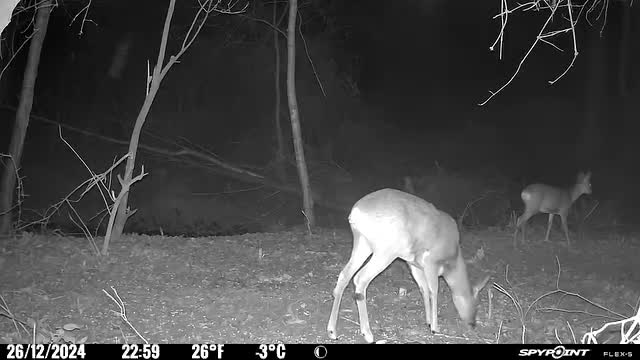
Around 6 p.m., the doe I already knew well from the trail camera images showed up at the acorn feeder on the left. Unfortunately she was heavily infested with some kind of skin parasite (probably sarcoptic mange, Sarcoptes scabiei); her condition was visibly deteriorated, her coat patchy and matted.
Since it was already dark, and I hadn’t mounted a permanent light on this feeder, this was the chance to try out the new Olight Marauder Mini 2 in a real situation.
The light is considerably better for hunting than its predecessor: it’s completely silent (the old one used to buzz faintly at the brightness endpoints), and the red light has its own dedicated button, so there’s no need to “coax it out.”
Using its wrist strap looped around the stand’s armrest, and resting it on top of the stand bag, I could position it so that, with minimal movement and in perfect silence, it lit up exactly the area of the acorn feeder.
On the lowest red setting the doe showed no reaction at all, calmly “grazing,” continuing to pick at the scattered feed. I gradually raised it two steps – by then the illumination was perfectly adequate for a shot – but the animal still paid it no mind. I watched for almost half an hour as she picked through the scattered feed, then she slowly moved off.
I had no intention of taking a shot at her, since what I really wanted was healthy, fresh, tender piglet meat for the Christmas table.
Around 9 p.m. a lone piglet arrived at the feeder, visibly lame in the left hind leg and in quite poor condition, with a hunched back.
He too showed no reaction to the red light at any intensity.
The Sidus Link app had recently been updated, and along with it came new firmware for my Aputure MC Pro lights, which I’ve been using to light the feeder for over a year now.
The previous “update” had turned out to be quite unfortunate, because the lights could only connect to the phone app over Bluetooth with great difficulty.
With this latest update I got back the earlier behavior, where the app finds the lights, 25-35 meters away, within half a minute at most, no matter how long they’d been sitting idle.
But the point is that this app has a number of light effects, and among the quick-access presets I’ve set up is one that imitates naturally occurring lightning.
Well, I tried this lightning effect too, which has worked in other cases – for instance with unwanted fallow deer or roe deer showing up – and has gotten them to quietly wander off.
Well, the piglet didn’t even react to that.
Since I didn’t want to make noise (in case other game was nearby), I waited until he’d eaten his fill and quietly moved on.
Around 1 a.m. a beautiful, mature, and extremely alert badger cautiously approached the feeder. It came in under cover of a large tree, and hesitated at the edge of the feeder. I watched it through the thermal camera for about half an hour before it ventured in a little further. At that point I switched the feeder light closer to it, in complete silence, to its glowing red mode (0.1% intensity). This had gone unnoticed by every animal so far, but it immediately “ruffled” the badger’s composure: it turned its back and trotted off. Ten minutes later it came back and went on crunching corn at the edge of the feeder. I gradually raised the brightness, but it still wouldn’t come out from cover. What’s more, it very craftily avoided the field of view of the trail camera watching the feeder area.
We played this game of “hide and seek” for another hour, until I finally pulled out the green laser pointer (at 25 meters, about a 1.5m-diameter circle). At first I aimed it high above its head and approached very slowly – but at the very first activation it bolted in a panic, crashing off through the brush.
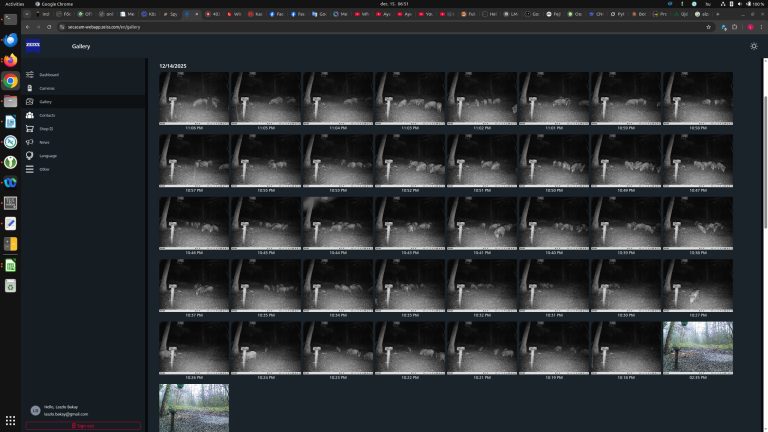
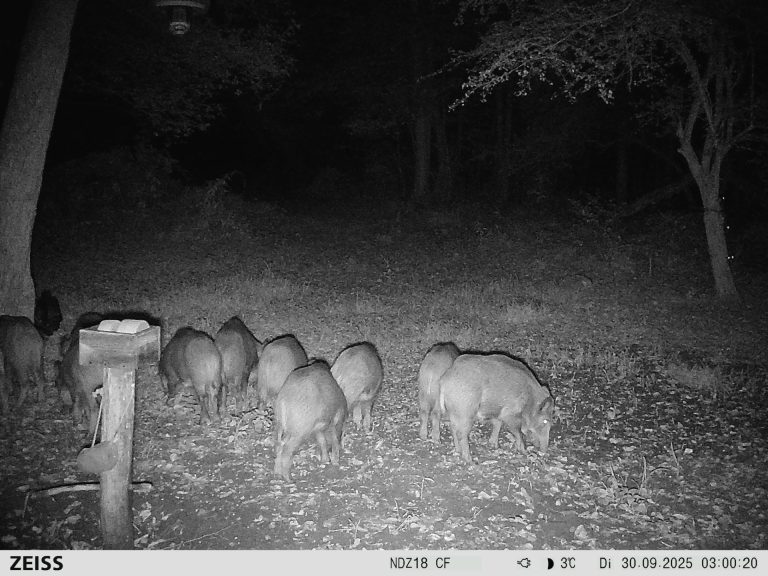
The group of 11 young pigs that regularly visits the feeder (piglets by now grown into young hogs) didn’t show up this time, even though they were the ones I’d mainly been hoping for. Even so, there was plenty of nighttime action.
At around -4°C, the carefully, precisely built layered clothing, sealed in by the Rascher one-piece suit, was a huge help. From time to time I also used the electric heating elements built into the seat cushion.