Moonlight-simulation lighting with cable-track movement for bowhunting
Moonlight-simulation lighting with cable-track movement for bowhunting
Thermal night hunting is being used in more and more places, and it’s clearly reshaping animal behavior.
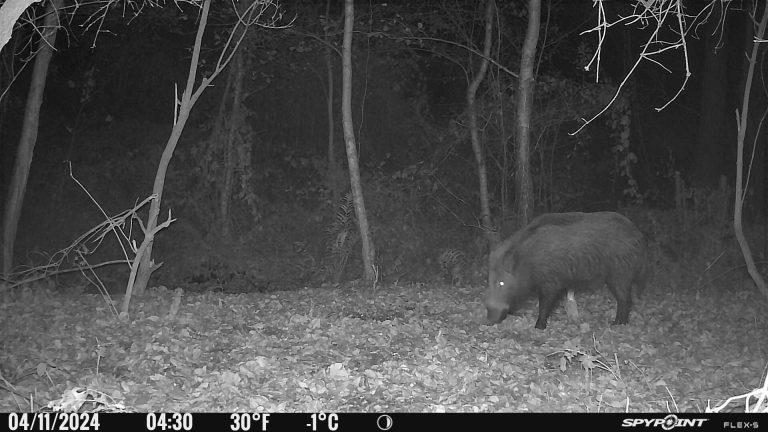
Wherever such equipment is used regularly, the population has become extremely sensitive to changes in light, so that even an almost imperceptible shift in illumination can trigger a flight reaction. This is especially dramatic with wild boar sounders: because of the group hierarchy and how quickly panic spreads, a single animal’s reaction instantly scatters the entire sounder, even before the hunter has noticed that anything has appeared.
With red deer too, even a seemingly insignificant, very faint-intensity light has resulted in immediate flight.
A conventional rifle lamp is ineffective not merely because of its brightness.
The problem is rather that the light appears suddenly, as a point source, and from a fixed direction — which recreates exactly the situation the animals already know from prior negative experiences.
Besides the sudden change in light intensity, it’s probably also suspicious to them that it comes from one single, defined point.
On top of that, there’s another extremely annoying problem.
Suppose you hear the animal, get ready for the shot, draw the bow, switch on the lamp, and then see that the boar is standing with its back to you, or is wagging its tail toward you.
You can’t take the shot. You hold the bow drawn for a while, but if the animal doesn’t turn, or bolts from the sudden light, you still have to let the bow down, because you can’t make an ethical shot on the vital zones.
That’s where the idea came from: imitate moonlight.
The moon is not a point light source, it doesn’t switch on suddenly, it doesn’t shine from one fixed direction, but provides even illumination from above.
If you use a low-intensity, neutral or slightly cool white light from a height of 4-5 meters, the animal cannot associate it with a single hunter’s position — provided the illumination doesn’t change abruptly.
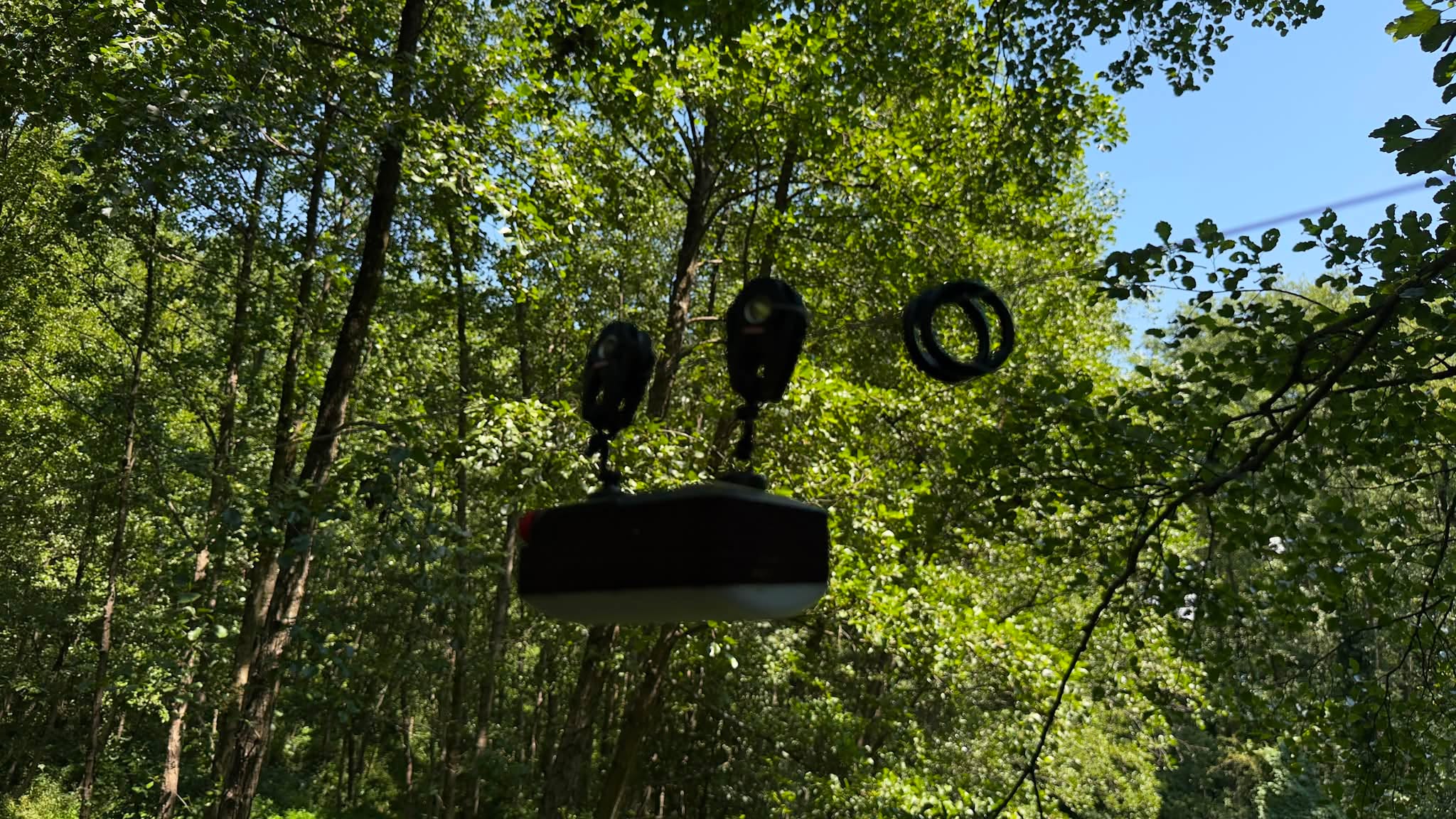
The Aputure MC Pro is excellent for this: small, light, with precisely adjustable color temperature and brightness, and it provides even illumination over extended periods.
During development, however, it became increasingly clear that there’s no universal lighting for every situation.
While the basic concept remains simulating natural moonlight, colored lighting can be advantageous under certain conditions.
One of the biggest advantages of the lamp used is that not only is the color temperature of the white light adjustable, but the RGB color mixing is also fully programmable.
Accordingly, I use several pre-made light profiles in the Sidus Link app.
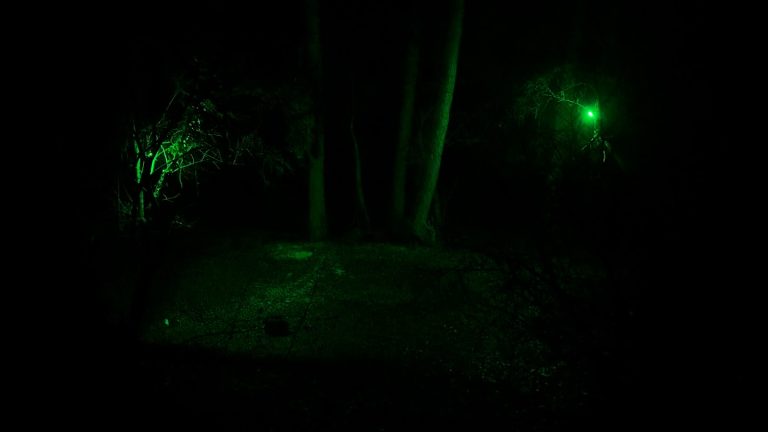
The default setting remains the low-intensity, neutral white light that imitates natural moonlight. Alongside that, however, I’ve also stored various intensities of red and green lighting.
These aren’t used because they’re generally the “better” colors, but because the animals’ reaction can differ significantly across different hunting grounds.
In places where the animals have already grown accustomed to associating white light with human presence or thermal night hunting, a very low-intensity red or green light may trigger a smaller behavioral reaction.
In other areas, however, exactly the opposite is observed. So at each site, the right setting has to be chosen based on local conditions.
The system is therefore not built around a single light source or a single color, but around a flexible lighting system.
A few seconds after taking up position in the stand, the hunter can select whichever profile proves most natural for that particular area — be it neutral white moonlight, faint green, or subdued red lighting.
My pre-made light profiles
* White light: 4750 K nominal color temperature (default setting for moonlight simulation).
* RGB light profiles:
* RGB 255/95/0 – orange-red
* RGB 255/36/0 – red, at minimum brightness the ambient illumination barely changes
* RGB 0/80/0 – optimum green
* RGB 0/185/0 – intense green even at minimum brightness
* RGB 0/18/0 – weak, deep green at maximum brightness
It’s important to stress that the goal is to create a constant, low-intensity ambient illumination that disturbs the animals’ natural behavior as little as possible, while still giving the hunter sufficient visibility for an ethical shot.
Professional note
Based on current scientific literature, it cannot be stated as a proven fact that red or green light generally disturbs wild boar less. The animal’s reaction is influenced by many factors – including brightness, the geometry of the illumination, how the light changes over time, prior experience, and the hunting pressure in the given area.
It’s therefore more accurate to say that the different color profiles are meant for field testing and adapting to a given area, rather than claiming that any one color is universally advantageous.
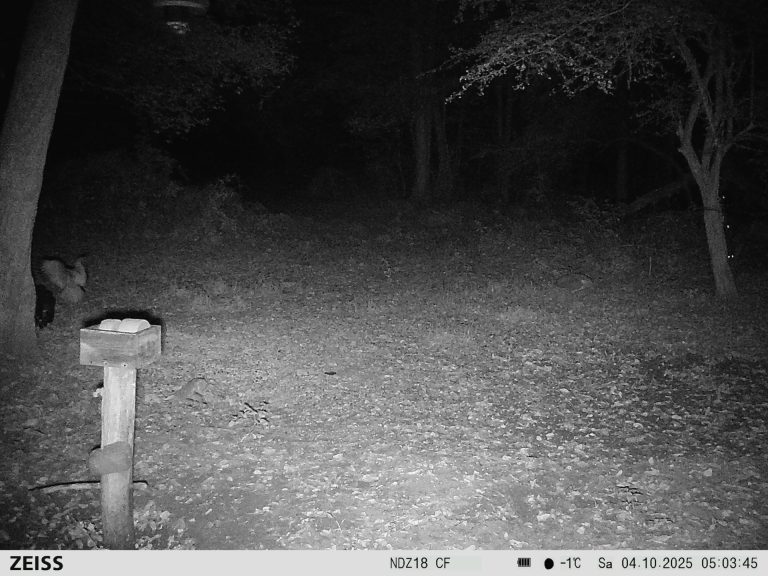
Previously I placed two such lamps at the two ends of the feeder, at a height of about three meters.
Longer runtime required an external USB power bank, which could be taken down each morning without having to climb the tree.
This setup worked, but caused two problems.
First, mounting and dismounting each time required climbing the tree near the feeder, which meant human presence and scent contamination.
Second, the power bank had to be connected before every hunt, which meant another human entry into the most sensitive part of the area.
So I started thinking about a cable-track solution.
The first prototype was an endless wire-rope loop, so that no separate control line would be needed. A wire-rope loop run over two pulleys – in theory a simple system: pull one side and the lamp goes forward, pull the other and it comes back.
In practice, though, it didn’t work out.
The rope needs to be taut so it doesn’t sway in the wind, but high tension causes significant friction on the pulleys. This means too much force is needed to move it, operation becomes noisy and imprecise – in other words, unsuitable for hunting purposes.
Stability and easy handling contradicted each other in this design.
That’s how we arrived at the single-strand cable track: the wire rope serves purely as the support structure, while positioning is handled by a separate, lightweight control line.
The risk of snagging can be minimized by clearing branches in advance and carefully planning the route. This is a far smaller intervention than the tensioning paradox caused by the endless-loop system.
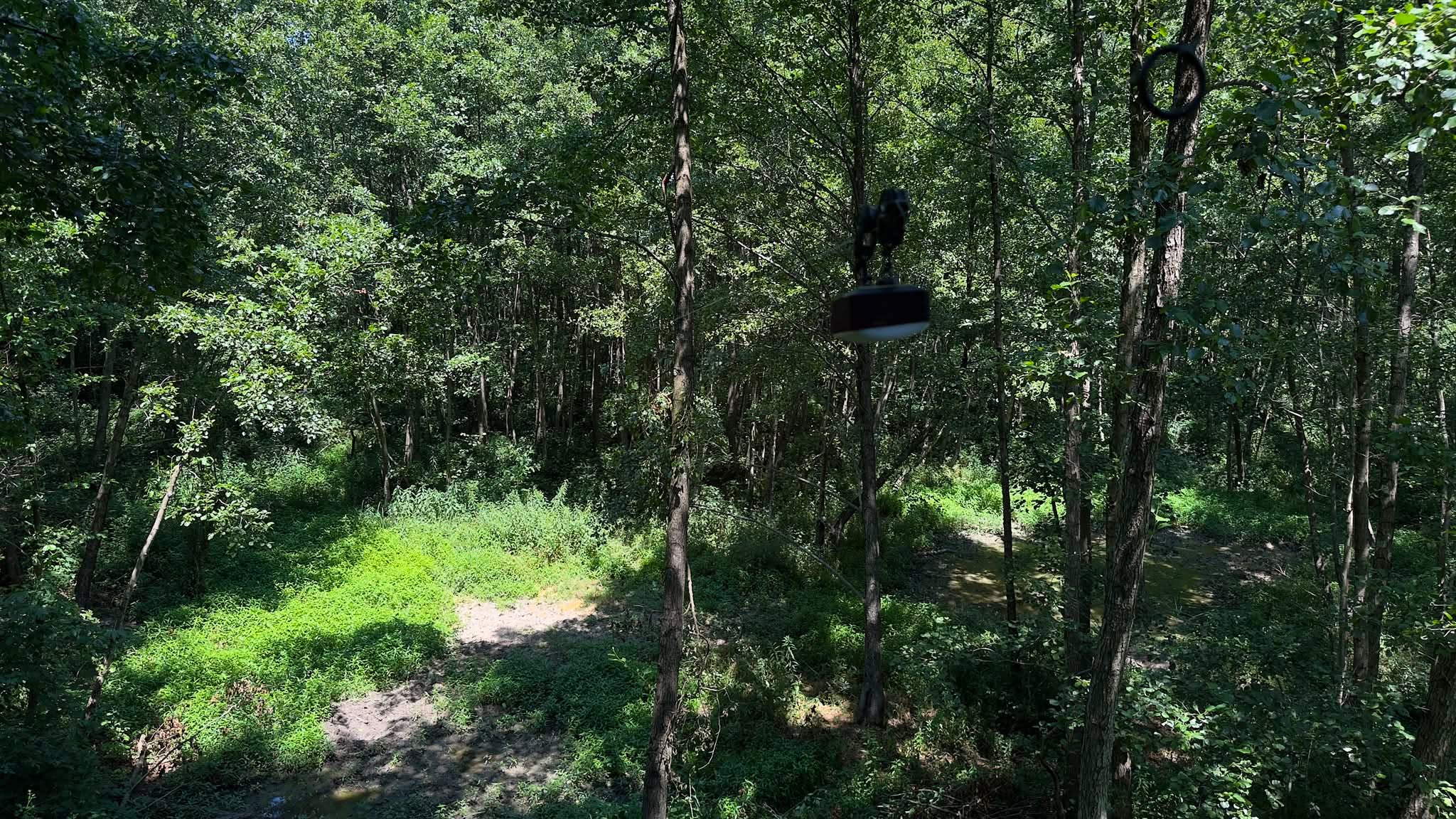
In the current system, I stretch a 1.25 mm diameter, 7×19 strand stainless steel wire rope with a slight downward slope from the stand’s tree to the feeder’s tree. The slope is about 5-7 degrees.
Running on this is a lamp mounted on a small pulley, connected to a thin control line. The other end of the line can be reached from the stand.
I previously tried a 1.5 mm Dyneema line, but it didn’t prove suitable. After about 8-10 meters, the weight of the line itself already slowed the lamp down, so it could no longer glide along the track.
I currently use 0.60 mm braided catfish fishing line. It’s light, extremely strong, and practically invisible, so it’s excellent for the task.
This way the lamp can simply be lowered from the stand out over the feeder, and pulled back again. There’s no need to enter the area around the feeder before or after the hunt at all, so scent contamination is practically eliminated.
There’s also no need for installation at height, since the 4-5 meter working height is provided by the geometry of the rope itself.
In the morning I simply pull the lamp back to the stand, bring it in to charge, and it’s ready for use again for the next hunt. The internal battery is sufficient for hunting purposes, since the actual lighting time doesn’t necessarily mean many hours of continuous operation.
The pulley can also be stopped beyond the point above the feeder, so the lighting can be adjusted to the animal’s expected point of appearance.
I don’t fix the far end of the wire rope rigidly; instead I tension it through a 60 mm pulley with a 10-15 kg counterweight. I currently use a stone of about 12 kg for this purpose.
This gravity tensioner dynamically compensates for the wind-induced movement of the trees. When the trees sway, the weight rises or falls, so the rope’s tension stays nearly constant, and the lamp doesn’t start swinging.
The 10-15 kg mass represents roughly 100-150 N of tension force, which stays well below the rope’s breaking strength.
A further advantage of the system is that it’s site-independent. It can be installed with the same principle between any two suitable trees, regardless of distance or height difference, without separate calculations.
It’s advisable to leave the counterweight at least 20-30 cm of free movement, and to make sure it doesn’t strike the tree trunk in the wind. This is easily solved with a short rigid bracket or by properly positioning the pulley.
For all outdoor components, the use of stainless steel (AISI 304 or AISI 316) is recommended, as these resist corrosion and freeze-thaw cycles well over the long term.
Summary
Throughout development, every single step was a response to a specific problem.
The endless-loop system showed that a wire rope cannot provide both high tension and easy movement at the same time.
The single-strand cable track and the separate control line successfully split these two tasks apart.
With the cable track in use, installation at height has been eliminated, and scent contamination around the feeder has been practically eliminated as well.
The gravity tensioner, meanwhile, ensures the system’s dynamic stability regardless of changes in wind and terrain conditions.
The result is a simple, easily installed system, usable between any suitable pair of trees, that ensures precise positioning of the light with minimal human presence.