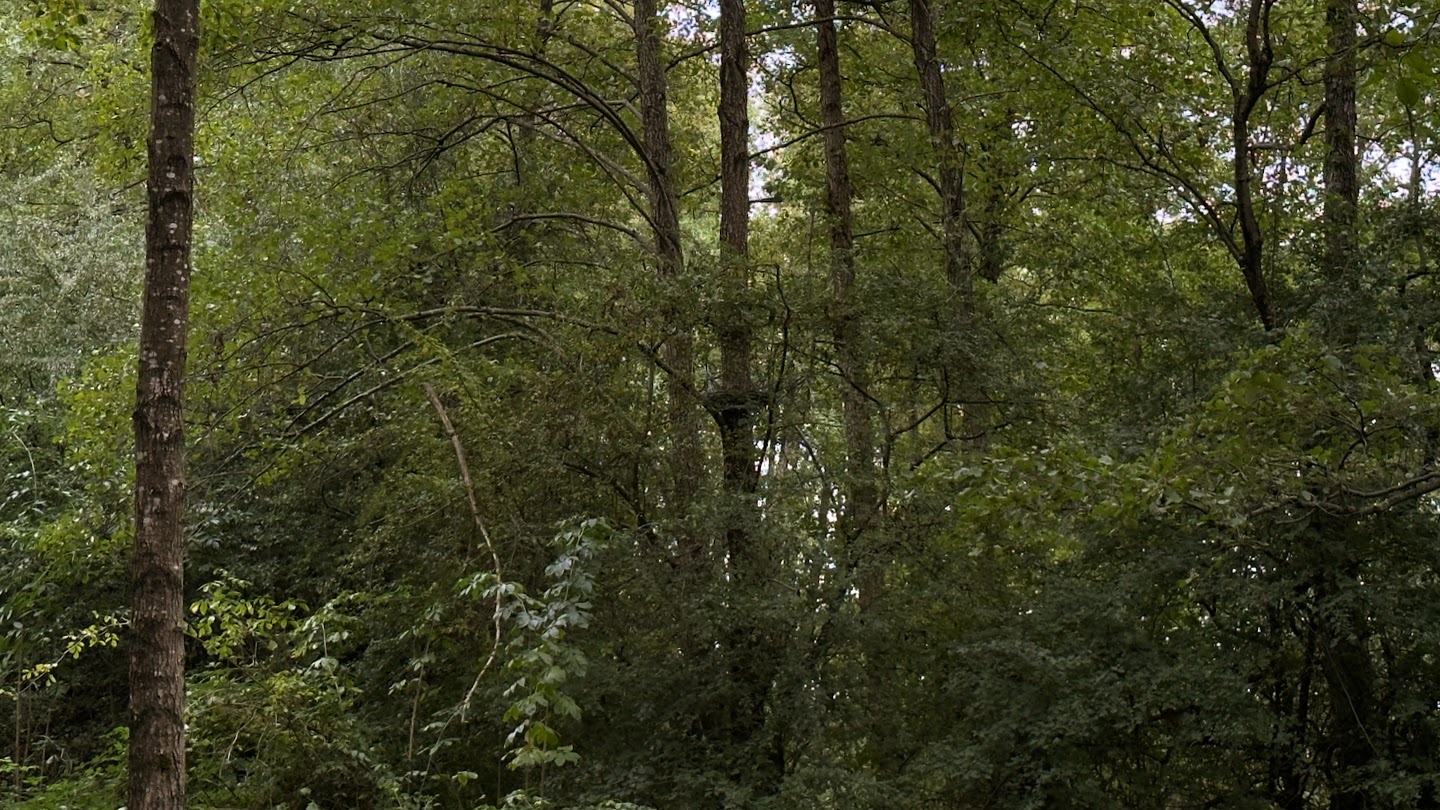
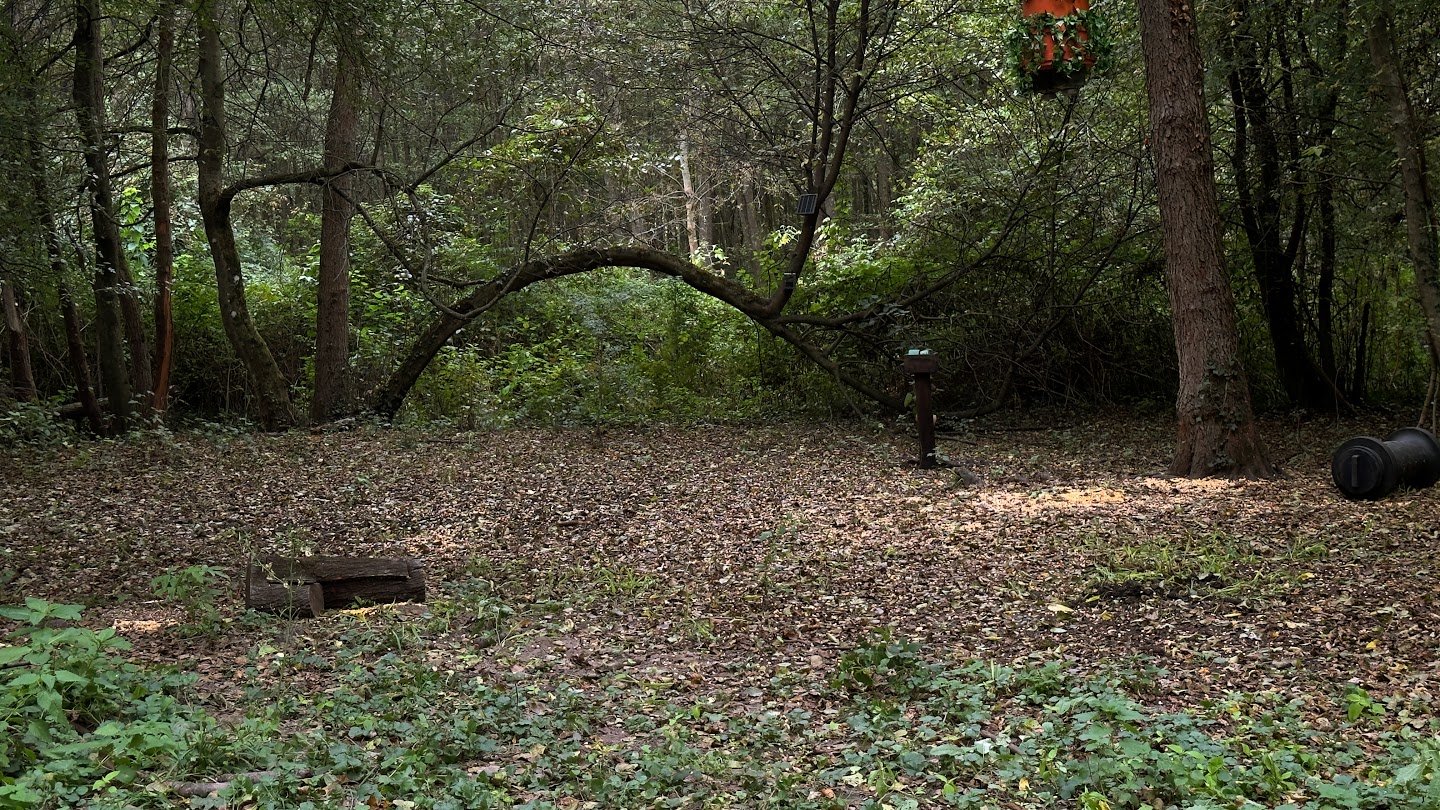
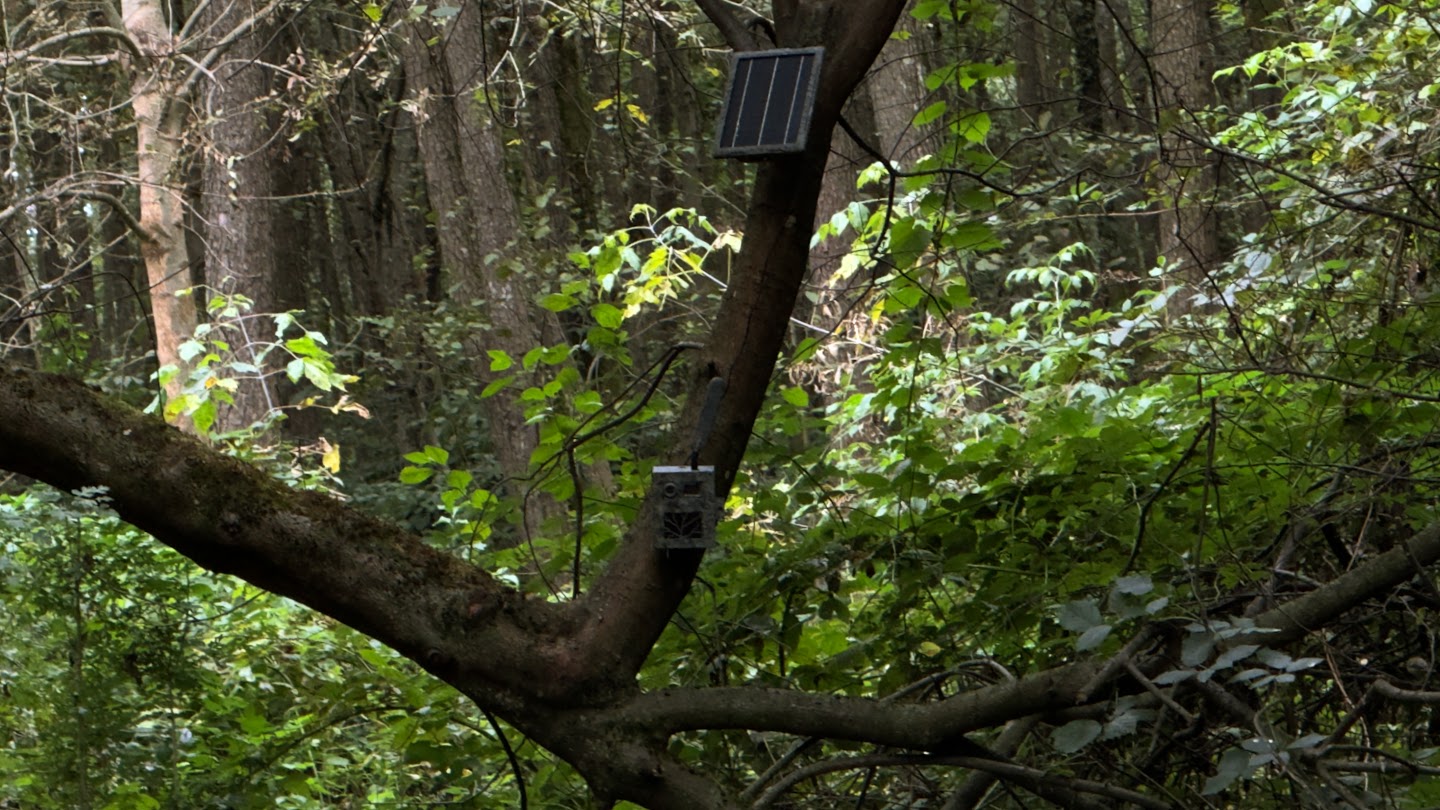
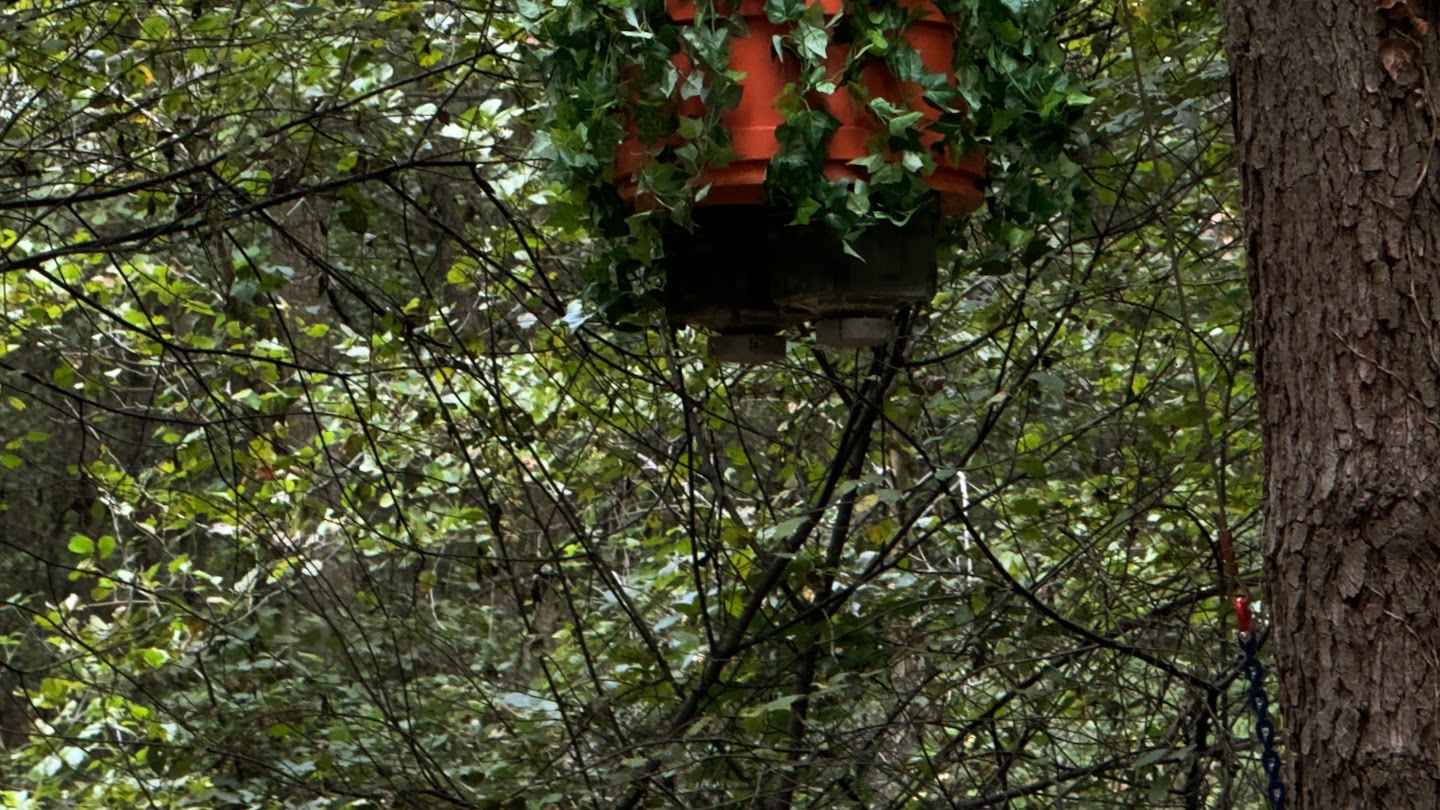
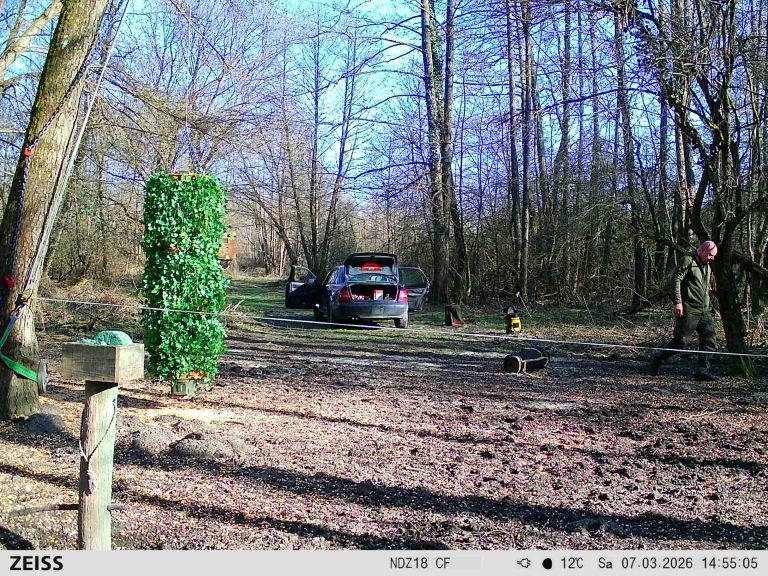
Find the stand!
Find the stand!
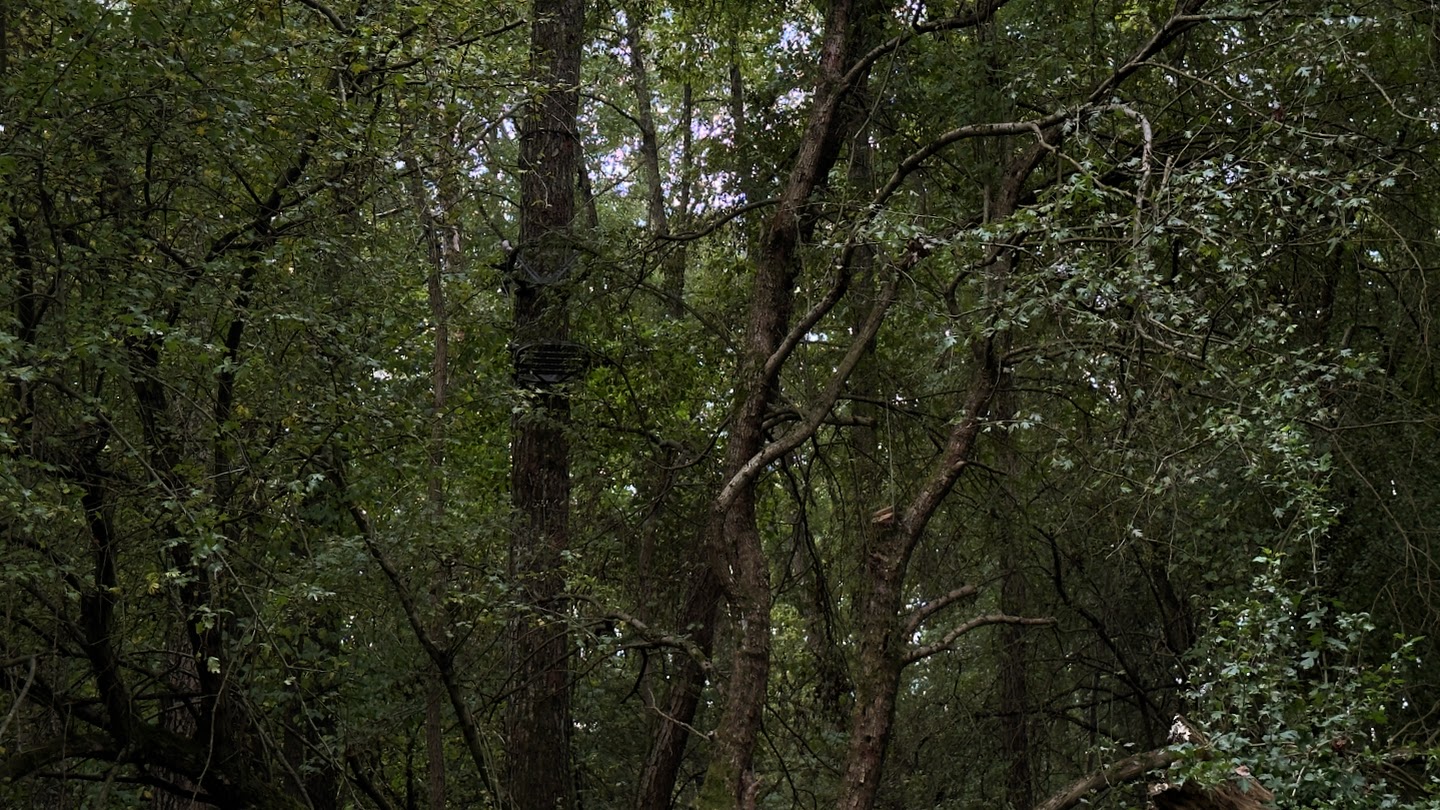
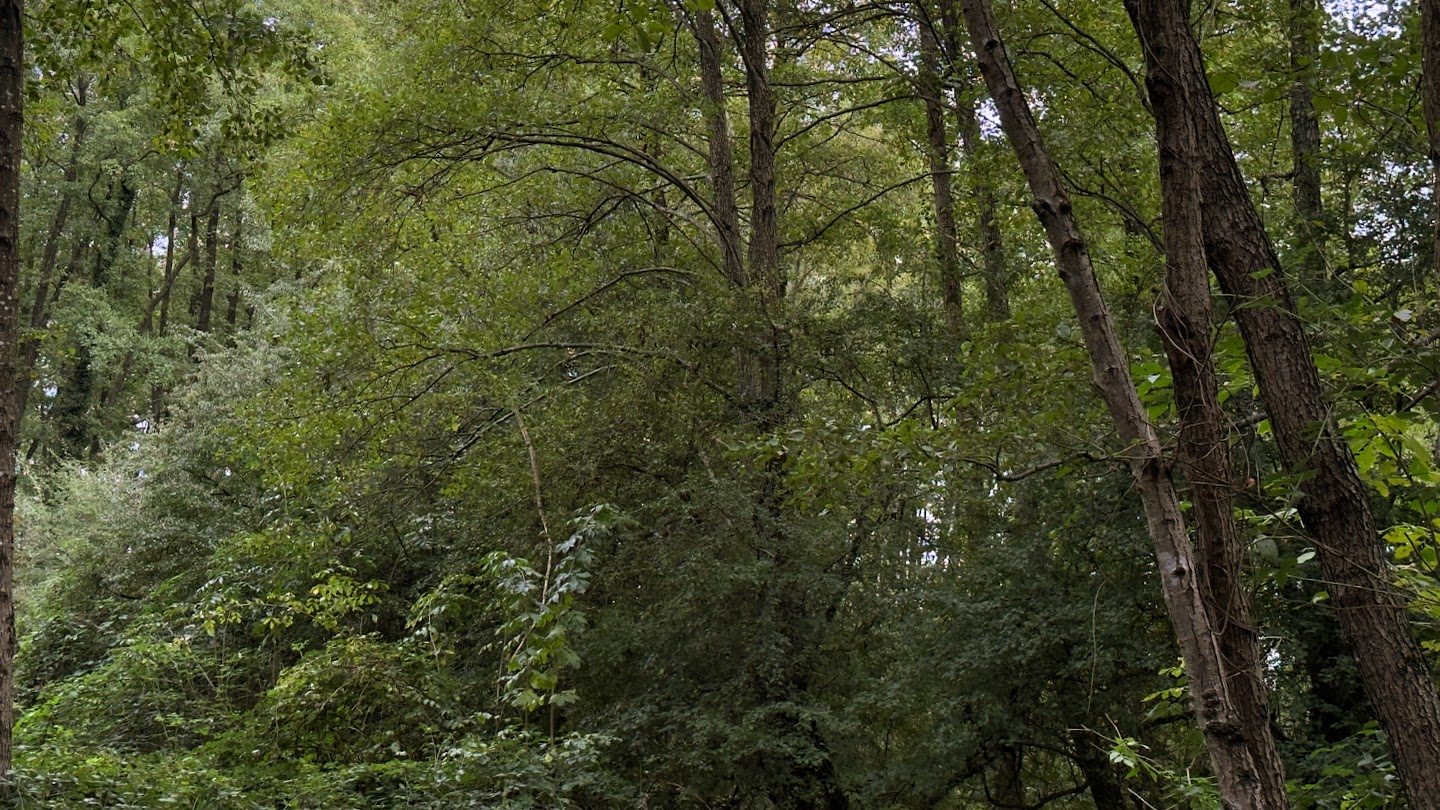
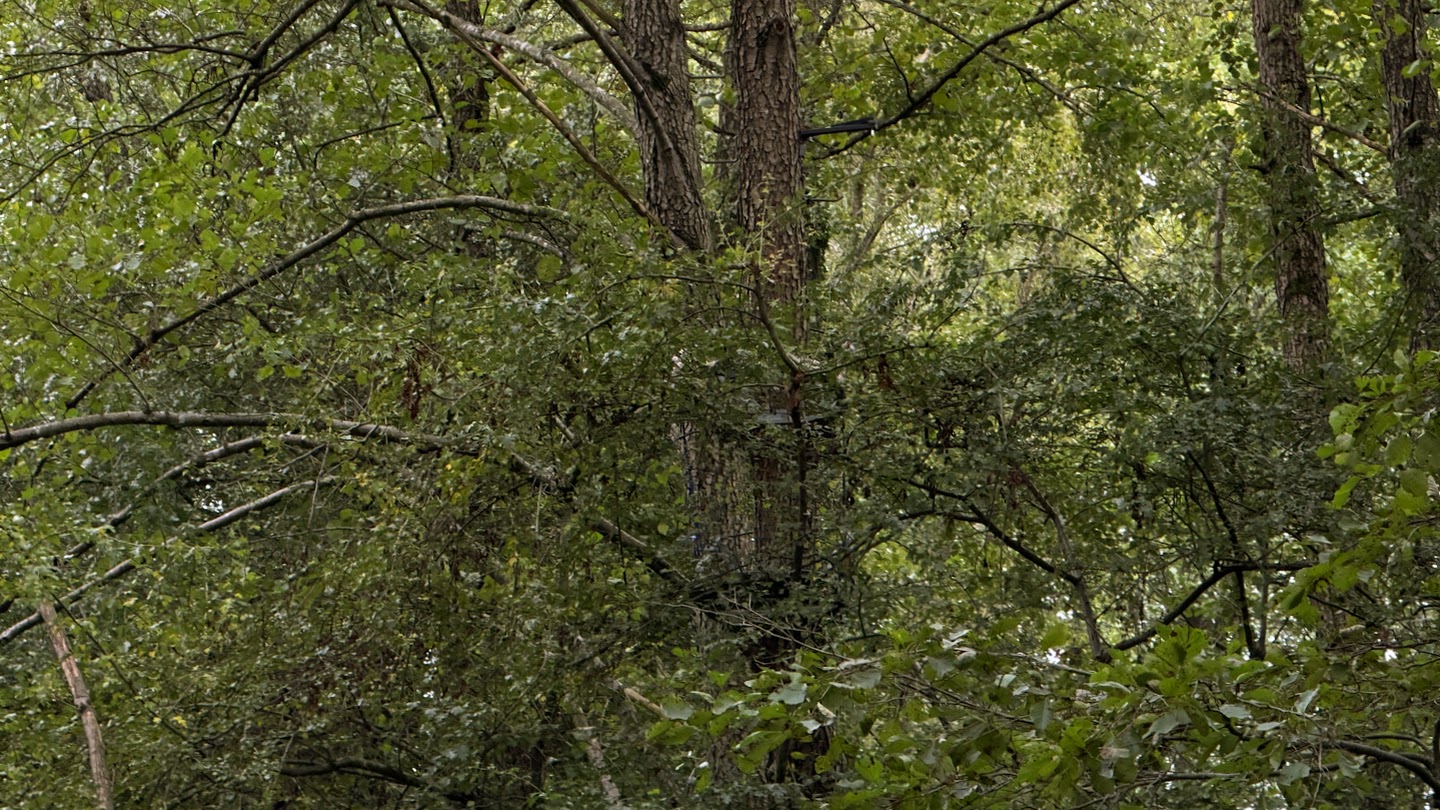
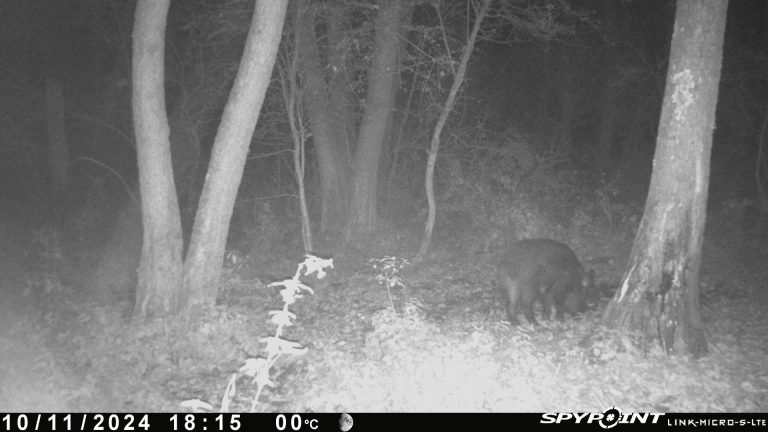
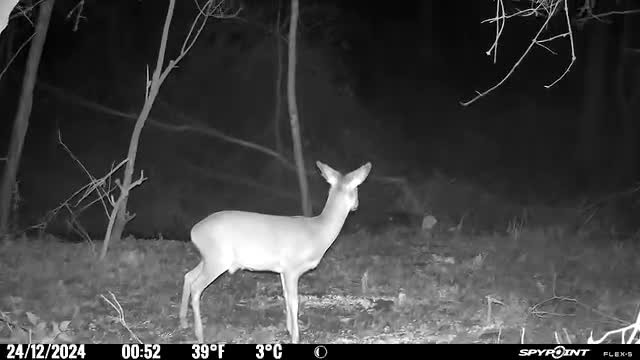
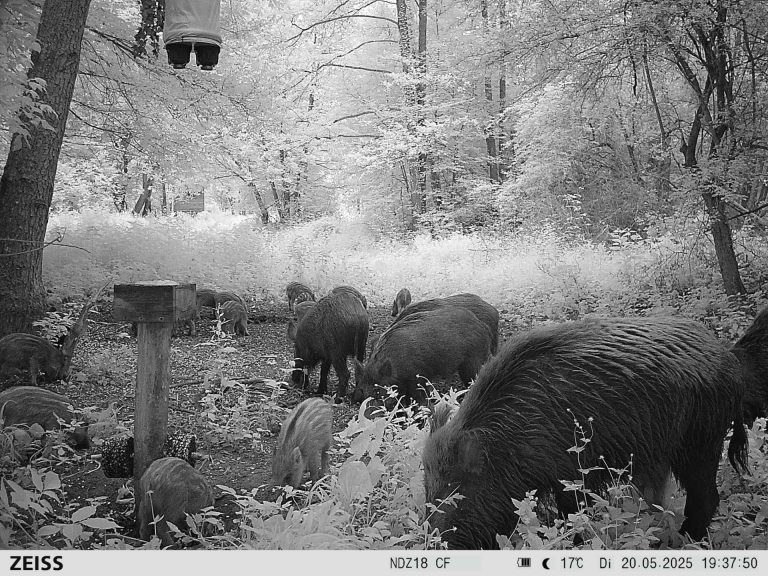
Or rather, a few pictures of the stands.
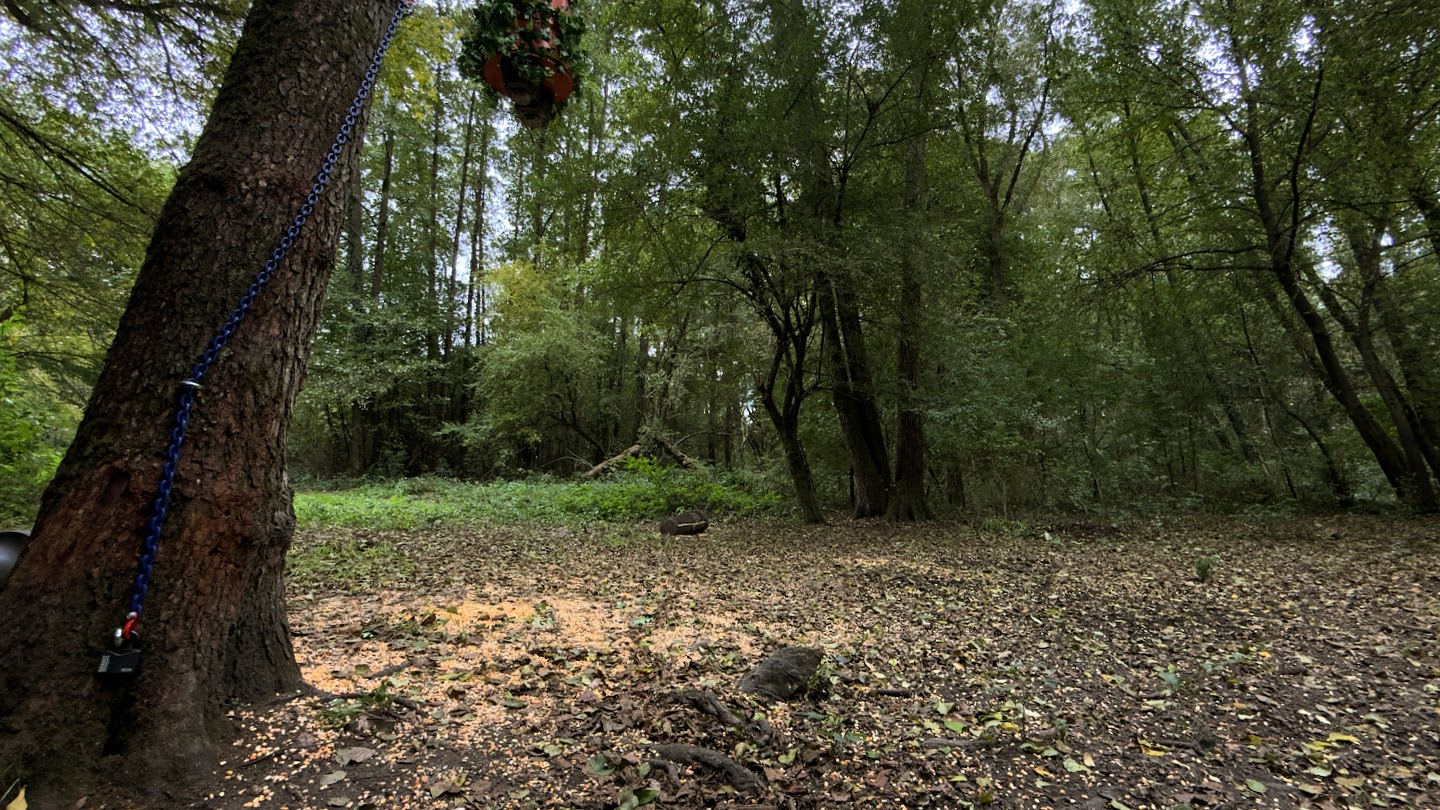
From the first one, there’s an excellent view of the big-tank feeder on one side, and on the left, a mini clearing baited with acorns.
The Big Green Wallow stand is a real “gem.”
It’s barely noticeable, hidden in the cover of a hawthorn bush.
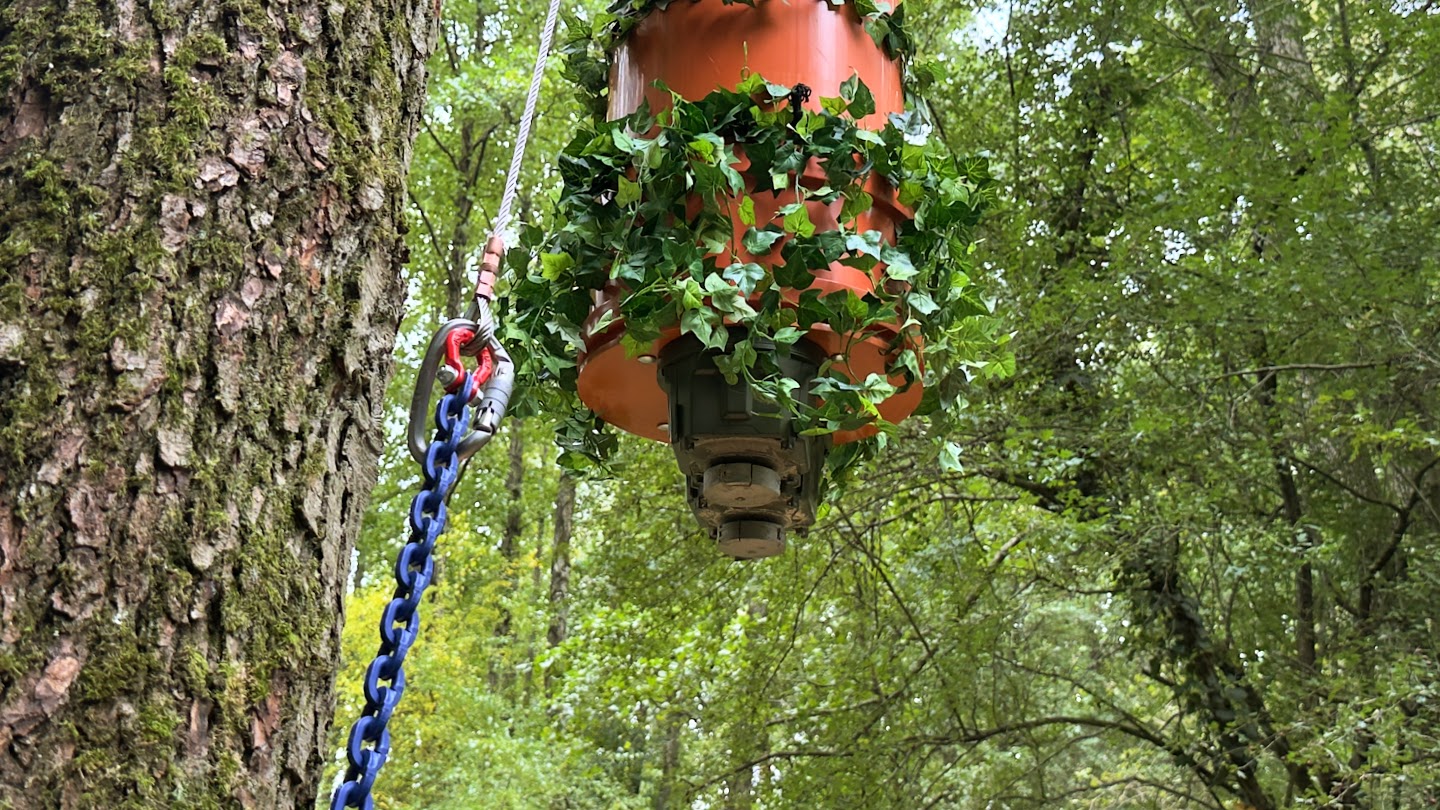
One of the pictures shows the final, though still partial, camouflage of the feeder tank, as well as the brutal chain and fastening used to secure the tank.
Once, in a hunting-related YouTube video, a heated debate broke out over whether hunting from a stand placed near an automatic feeder and a trail camera even counts as hunting at all.
Well, in my opinion, the problem isn’t the automatic feeder or the trail camera, but the current practice of hunting.
On hunting grounds, a careful game manager traditionally feeds the wildlife regularly, putting out grain and roughage, especially as the cold weather sets in.
The trail camera isn’t just a fancy indulgence with no precedent either.
The predecessor of the camera used to be the so-called “game clock.”
This is a waterproof timepiece, resistant to all physical impact, which stops when knocked over.
Placed on the feeder, it keeps “ticking” until the game passing by knocks it over, at which point it stops and shows when the animal was there.
Before the camera became available, this too served its purpose well.
Of course, the camera provides incomparably more information: it shows when and what animal was there, how many animals visited the feeder during the night, how long they stayed, and so on.
So that’s not the problem.
The problem lies in the current culture of hunting.
And this “culture,” in turn, is connected to a more general social problem.
The Age of Instant Gratification and the Transformation of Hunting: Sociological and Psychological Perspectives
One of the most defining phenomena of modern society is the pursuit of instant gratification, which profoundly influences our individual and collective behavior patterns, our value systems, and our cultural practices.
This tendency shows up not only in our consumer habits but also in ancient activities such as hunting.
The purpose of this piece is to explore the social and psychological roots of instant gratification and to show how this phenomenon is transforming the essence of hunting — eroding its romance, its excitement, its centuries-old traditions, its culture, and its ethical foundations.
The social and psychological roots of instant gratification
The inclination toward instant gratification is fed by a number of factors in contemporary society:
Technological development and information abundance:
The spread of the internet, mobile communication, and digital platforms has radically accelerated the flow of information and interactions. Almost everything is instantly available — whether it’s knowledge, entertainment, products, or services. This constant access has created a kind of “instant culture,” in which waiting, patience, and delayed reward are pushed into the background.
The pressure of consumer culture:
In post-industrial societies, consumption is the engine of economic growth. Advertising and marketing strategies constantly encourage us to acquire new products and experiences as soon as possible. Messages of “available right now” become embedded in the collective consciousness, reinforcing the belief that the source of happiness lies in quick satisfaction.
The workings of the dopamine system:
From a psychological standpoint, instant gratification is closely tied to the brain’s reward system, particularly the release of dopamine. Quick success, “likes,” short videos, online games — all generate a dopamine hit, producing a pleasant feeling that reinforces the behavior. This can create a kind of “addiction,” in which the individual constantly seeks out the next quick reward.
Stress and the sense of control:
In an accelerated, often unpredictable world, achieving instant results can give a sense of control and ease stress. When we see quick results, it reassures us that we’re capable of affecting our environment — even if this “success” actually stems from an artificially generated situation requiring minimal effort.
The shallowing of life experience:
When we want everything right away, immersion, enjoyment of the process, and the desire to overcome difficulties can fade into the background.
Instead of achieving goals that require perseverance, life’s complexity gives way to superficial, quickly-arriving “feelings of success.”
Hunting and instant gratification:
the dilemma of the thermal scope
For centuries, hunting embodied a deep, complex connection between man and nature.
It involved patience, observation, tracking, natural-history knowledge, and physical stamina.
The “romance” of hunting lay in the hunter measuring himself against nature and against the game’s refined, God-given senses, giving the animal a chance, with success being the result of perseverance, knowledge, and luck.
Modern technology, especially the advent of thermal riflescopes, is shaking this traditional paradigm to its foundations:
The end of a level playing field:
A thermal riflescope allows the detection and taking of game day or night, even from several hundred meters away, with extraordinary precision. This effectively eliminates the animal’s natural defense mechanisms, such as camouflage, hiding, and the advantage of nighttime movement.
For the animal — without much exaggeration — mere existence can become life-threatening.
The radical transformation of game behavior:
As a result of thermal-scope hunting, the behavior of the game population also changes fundamentally.
Surviving animals develop extraordinary caution and tension. They react radically to the slightest change in an environment they once considered safe. If anything changes — even if the same feed arrives from a different source, or a different crop/fruit is put out — the animal abandons the spot for days, unwilling to take the risk.
Even the faintest suspicious air current can be enough to trigger flight.
The declining chances of traditional hunters:
If the animals become this wary, the chances of traditional hunters drop sharply.
The smallest change in light conditions triggers immediate flight, so even the mere thought of using a weapon-mounted light becomes, at times, quite problematic.
Old solitary boars that have lived a good number of years, or sows leading their endlessly cautious piglets, seem to have developed some mysterious ability whereby, even in a “good wind,” they can detect a motionless hunter sitting 8 meters up in a tree within 40 meters.
They approach the feeder, or any other target spot (wallow, a fruit tree dropping ripening fruit, a salt source, etc.), strictly according to the current wind direction, only ever approaching against the wind… and so on.
“Killing” as the goal, not as the outcome of a process:
In traditional hunting, the kill was the culmination of a long, persistent, and exciting process. With the use of the thermal scope, the kill is reduced to a mere technical act, an instant “feeling of success” available at the push of a button. The emphasis is on the efficiency of the “kill,” not on the experience of the hunt itself.
The loss of “romance”:
The magic of hunting lay in the discovery of the unknown, in the tense silence of sitting on stand, in the quiet, fair contest and dialogue between hunter and game.
Or in those moments during a stalk on a cool, misty September dawn, when nature’s picturesque beauty surrounds us.
That moment when, after long hours, the hunter finally notices a tiny sound that, from experience, he knows carries meaning, when “the thermometer of hope rises within him,” and then he catches sight of the animal — that blend of excitement and anticipation.
The thermal scope destroys this aura, because the animal becomes a “heat blob appearing on a screen,” not a living, free creature whose outwitting requires caution, creativity, resourcefulness, skill, experience, perseverance, and patience.
The changing identity of the hunter:
Where the hunter is no longer a connoisseur of nature but a technologically equipped “game-killing machine,” the hunter’s very identity is called into question.
Hunting becomes a triumph not of skill but of equipment. This undermines the values that once defined hunting: respect, knowledge, perseverance, and responsibility.
Conclusions and ethical considerations
The age of instant gratification, through the transformation of hunting, raises serious social and ethical questions:
The blurring of ethical boundaries:
Where is the line between responsible game management and mere “game-killing,” or even “mowing down game” (a term I didn’t coin either…), if technology removes every limit?
The loss of traditional values:
If hunting loses its challenge, its romance, and the enjoyment of the process, then what remains of it?
Will it hold any deeper meaning at all for future generations?
The distortion of our relationship with nature:
Excessive use of technological “aids” can alienate humans from nature. Instead of the hunter blending into the surroundings, he becomes a kind of “outside observer,” a “destroyer.”
The social acceptance of hunting:
Images of thermal-scope “hunting” undermine society’s view of hunting. To the general public, it looks more like one-sided slaughter than responsible game management.
In summary, the pursuit of instant gratification is one of the deepest challenges of modern society, and it has reached hunting as well.
The spread of thermal riflescopes shows that technological progress doesn’t always mean an ethical or experiential step forward.
For the future of hunting, it is crucial that hunters — and society more broadly — recognize the traps of instant gratification and return to the values that made hunting a noble and meaningful activity for centuries: respect, patience, knowledge, and harmonious coexistence with nature.
Well, after all this, let me return to what I raised at the start of this piece:
“whether hunting from a stand placed near an automatic feeder and a trail camera counts as hunting at all.”
My own opinion is that at 40 meters or less, and provided we remove thermal imaging and night-vision scope technology from the equation, yes, it is hunting.
With a bow, absolutely.
The large-tank feeder, which only needs refilling once a month
(10 minutes of disturbance on the grounds), somewhat compensates for the reduced chances caused by the animals’ endlessly cautious behavior described above.
The Hunters’ Chorus
How good it is out in the forest,
When the hunt is on,
When dawn is breaking
And the sun comes up!
The horn’s call rings out,
The many riders gallop
And, crashing through the brush, chase
The swift game.
This is a glorious life,
Befitting a man,
It tempers the muscle
And lifts the spirit,
When the forests and rocks
Ring with echoes,
Hey, sweeter and merrier
Rings the cup.
Ho tra la, la, la.
When moonlight paints
The sky pale,
And over the land spreads
The magic of night,
To lie in wait for the bloodthirsty boar,
For the wolf,
That’s when the brave hunter
Sets out.
This is a glorious life,
Befitting a man,
It tempers the muscle
And lifts the spirit,
When the forests and rocks
Ring with echoes,
Hey, sweeter and merrier
Rings the cup.
Ho tra la, la, la.